Archive for 2011

Where There’s a Wren, There’s a Way

Thursday, May 19th, 2011

One afternoon in early May, I almost stepped on what looked like a little pile of brown lumps by the driver’s side of our car, in the garage. When I leaned down and looked closer, the little brown lumps looked back up at me with bright black eyes.

Three Carolina Wren fledglings were huddled there on the concrete floor, and must have just come out of a nest. A leap of faith that had ended, for the moment, on a cold, hard gray floor – with no sign, perhaps, of the grass and leaves and sky they’d been promised. When I opened the garage door, one of the young birds flew immediately to the sunshine and bushes just outside, but these two stayed where they were for several more minutes, ignoring the calls of the parents. Meanwhile, another baby wren plunged down from a box on a shelf on the wall of the garage, and quickly out the door. The two on the floor finally flew out, too, with a little careful nudging. So at least four young Carolina Wrens successfully fledged from the nest and made it out to the wide, bright, dangerous world beyond.

For several days before this, we had heard peeping from somewhere up in a corner of the garage, so we started leaving the door cracked at the bottom, though now and then we forgot, and closed it again. We usually keep it closed for just this reason – to discourage Carolina Wrens from building a nest in a box or clay pot or inside an old lampshade. We still don’t know how a pair managed to get in and out often enough to raise a family, but somehow they did. They must have been coming in through cracks around the garage door that would barely be big enough.
A Young Blue Grosbeak Singing

Wednesday, May 18th, 2011

In a patch of small pines and oaks on the edge of a clearing this morning, a Blue Grosbeak flitted from branch to branch, singing short pieces of its richly warbled song. It looked and sounded familiar – the large peaked head, the very large silver, conical beak and longish tail – and this is an area where Blue Grosbeaks have often nested in previous years. But something about this one was different.

Most notably, it wasn’t blue at all – certainly not the deep ink-blue of a Grosbeak with rust-orange wingbars – or even the dark gray-blue that Grosbeaks can appear to be in certain light. This one was brown. A pale brown on the belly, with darker brown on wings and head, similar to a Blue Grosbeak female – but female Grosbeaks do not sing.

I think this was probably a first-summer or sub-adult male, not yet in the full blue plumage of a mature male. There probably was some blue in the plumage that I couldn’t see because of the way it stayed mostly in the shadows of the leaves.

It seemed interesting to me that this young male was not singing the way a mature Grosbeak usually would – perched up in a treetop or top of a bush or on a wire, out in the open, singing its song repeatedly and boldly. Instead, it sang as it moved around in the trees and shrubs from place to place, staying low and screened among the needles and leaves of small trees. And the song itself was slightly different, a more casual, off and on series of fluent but less emphatic warbled phrases, fragments of the full song, and the effect was strangely more musical.

After several minutes in these trees, the Grosbeak flew across the road into low shrubs and grassy weeds along the edge of the old field, and from there began to give its hard, metallic chink call, several times. Then it flew again, into some large old oaks with privet and other shrubs around them, so I could no longer see it, but I continued to hear the chink calls.

Great-crested Flycatcher

Thursday, May 12th, 2011

After being away for most of the first two weeks of May, I returned home to unseasonably warm weather, even for here, with a string of sunny days and temperatures in the low 90s. Suddenly it’s summer. Among the familiar sounds that welcomed me home were the rich Breet and Whreep calls of Great-crested Flycatchers – one of the first things I heard when I stepped outside.

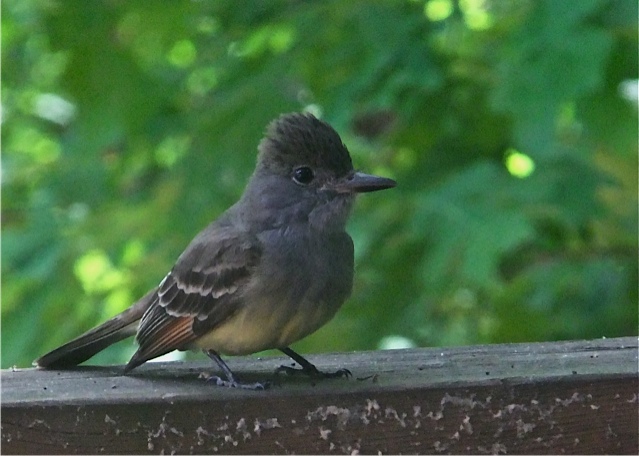
We often hear these calls in the trees around our yard, and occasionally these large, handsome flycatchers even visit the deck – like this one, which stayed around for several minutes yesterday afternoon, hawking insects from the air and also hunting around the umbrella and corners of the deck rails and windows.

The songs of Summer Tanager, Pine Warbler, Chipping Sparrow, Eastern Bluebird, Northern Cardinal, Brown Thrasher and Northern Mockingbird also greeted me, and the spee calls of at least a couple of Blue-gray Gnatcatchers – though they seem less common here than in past years – the rattles of Red-bellied Woodpeckers, the trumpeted call of a Pileated Woodpecker, and the swishy songs of Eastern Phoebes. Chimney Swifts twittered and swept overhead. Two Red-tailed Hawks soared and circled.

A pair of Ruby-throated Hummingbirds comes frequently to the feeder on the deck. Red-eyed Vireos sing steadily from the woods, and other birdsong this morning included a Scarlet Tanager near the top of a tall sweet gum, a Louisiana Waterthrush along the creek, a Black-and-white Warbler in trees along the roadside in a wooded area and – finally – a White-eyed Vireo in the Old Field. I had begun to think one would not return here this season. The effervescent songs of House Wrens also have arrived in the yards of several homes around the neighborhood, bubbling like musical fountains.

Four Red-shouldered Hawks circled high overhead at one time, near noon, one or two of them crying kee-yer repeatedly, and two of the four circling up higher until they became specks and then disappeared completely, melting into the blue.

The most haunting sound of the morning was the high, clear whistled pee-eeeeeeee of a Broad-winged Hawk. It came from somewhere to the north, beyond the wooded area where a pair of Broad-winged Hawks nested last summer. I’ve been watching for them and hoping they might return, but this is the first time I’ve heard one – and I only heard it call a couple of times, and did not see it, though I watched and waited for several minutes.

Last Days of April – A Myrtle Warbler’s Farewell Song

Wednesday, May 11th, 2011

On April 29 in the morning, under a deep blue, very clear sunny sky, a sweet whistled series of notes came from the green leaves of one of the oaks over our deck. The song sounded so pure and lovely I had to look to make sure – it was a Yellow-rumped Warbler in bright spring plumage, singing more fluently than any I’d heard before this.

All winter long, Yellow-rumped Warblers are abundant here, as in much of eastern North America, little gray-brown birds in drab, streaked winter plumage punctuated by a yellow patch on the rump and pale yellow smudges on the sides, frequently giving dry, colorless check calls as they fly like windblown leaves from spot to spot among trees and shrubs.

Before they leave in the spring – for breeding territories in northern and western forests –Yellow-rumped Warblers begin to fill the new green foliage of hardwood trees with gently jangling music, like delicate tambourines, and their plain plumage turns to a striking pattern of steel-gray back and wings, white wing-bars, white throat, black mask, and black-streaked vest over a white belly – and a yellow spot on the crown, and of course, a yellow rump.

For the past few weeks, their songs had filled many trees, and I’d listened to them mostly as a chorus of birds singing together. This was one of the few times I had listened to just one spring-colored Yellow-rumped Warbler singing alone, and watched as it lifted its head, parted its beak and sang – and flitted from branch to branch of the white oak. It seemed to me like a farewell song, and I took the time, for a change, to fully appreciate a winter bird I too often take for granted.

The next day I left for more than ten days of travel, and when I returned yesterday, the Yellow-rumped Warblers seemed all to be gone.

I used to know Yellow-rumped Warblers as Myrtle Warblers, a much more lyrical and fitting name, before they were grouped together with Audubon’s Warbler into one species with the sadly unimaginative – though descriptive – name of yellow-rumped. The two subspecies are still recognized, however, and this one was a Myrtle Warbler, distinguished by its white throat (not yellow). Most Yellow-rumped Warblers in the eastern U.S. are Myrtle, while Audubon’s are more common in the west.

Scarlet Tanager

Tuesday, April 26th, 2011

About 9:30 this morning, the air felt very warm already, and humid. Big gray and white clouds blew from the south across a mostly sunny blue sky. A Great-crested Flycatcher called Breet from the treetops across the street, a Carolina Wren, Northern Cardinal, Tufted Titmouse and Chipping Sparrow sang.

Among the green leaves near the top of a tall pecan tree, a Scarlet Tanager gleamed like a small red sliver against the sky, its color so intense, to see it felt like a shock. A clear, glassy red with slashes of ink-black wings, formed into a smooth, compact shape.

It was quietly moving around in the leaves and hawking insects, flying up to catch one, settling back in a slightly different spot, but staying in the same treetop for three or four minutes before it flew away.

Later in the afternoon, the crisp, dry CHICK-brrrr calls of a Scarlet Tanager moved through the trees outside my office windows. Usually elusive birds, despite their flamboyant colors and brassy songs, they tend to stay hidden in foliage and deeper in the woods, so it feels lucky and unusual to have them so close around.

Mississippi Kites

Friday, April 22nd, 2011

Earth Day here has been a cool, cloudy, damp spring day of gray light and glassy-green leaves all around. It began before dawn with a good hard rain. After the rain, an Eastern Phoebe sang. Then a Scarlet Tanager, a Summer Tanager, a Red-eyed Vireo, and a gathering cascade of birdsong.

By late in the morning things seemed rather quiet when I first went out, but by the end of an hour-long walk, I had been surprised to see two Mississippi Kites soaring, a Blue Grosbeak perched in a chinaberry tree, and to hear the sharp WHEET-sit call of our first Acadian Flycatcher of the season.

The Mississippi Kites were the most unexpected sight because it’s early in the season to find them here. I think of them as summer birds. But there they were – against a chilly background of gray clouds, two falcon-like raptors circling, flying close together and fairly low. Their sleek, streamlined shapes are so distinctive – long, slender, pointed wings, long tails and round heads. They drifted with wings outspread, tails fanned, riding the air like gray paper cutouts of bird shapes. After five or six minutes in view, they sailed away slowly toward the south.

Mississippi Kites spend winters in South America, and breed across the central and southern U.S. Graceful, acrobatic flyers, they catch and eat insects in flight, and can be a joy to watch. Though I’ve never seen more than five or six together at one time over our own neighborhood, they commonly forage in flocks of two dozen or more. During summers here, they’re more often found in rural areas, hunting over fence-rows, farm fields and pastures. Over the past few years, though, I’ve also seen reports of them in other wooded suburban areas.

Blue Grosbeak – First of the Season

Friday, April 22nd, 2011

From the top of an oak by the side of the road, across from the old field, I heard several emphatic, metallic chink calls. Just as I got close enough to see it, the Blue Grosbeak flew, but perched again only a short way down the road in the top of a chinaberry tree, in full view. In the gray light, it didn’t look very blue, just dark, but I could see the rusty orange wing-bars and the big silver, conical bill, and it continued to call chink!

Unfortunately, though, at the same time I heard no White-eyed Vireo singing in the nearby field. Although they usually are among the earliest migrant birds to return in the spring, this year I’ve only heard one singing in the field and one in an area of thickets near our yard, and each of these I only heard one day, and not again. I’m always amazed that any birds at all find the old field along the highway an attractive place to nest – although it’s lush with weeds, shrubs, vines and a good many large trees now in some places, the noise of tractor trailers and other traffic gets louder every year. So I’m not too surprised if birds choose to go somewhere else. Each year, it seems, fewer species return. And I really don’t know whether to hope a White-eyed Vireo will show up yet – or not.

Acadian Flycatcher

Friday, April 22nd, 2011

The Acadian Flycatcher sang its sharp, dry WHEET-sit from down in the woods along a creek. In the same area, a Black-and-white Warbler continues to sing weesa-weesa-weesa, a Northern Parula gave its buzzy, rising and falling song, a Blue-gray Gnatcatcher rasped spee-spee, a Pileated Woodpecker trumpeted and clucked, and a Red-shouldered Hawk cried loud kee-yer and circled overhead.

Ruby-crowned Kinglets fussed and sang, and one White-throated Sparrow’s sweet, high, whistled song drifted up from somewhere in the distance. American Goldfinches and Yellow-rumped Warblers filled many of the trees with a shimmer of music.

Although it seems to me there are noticeably fewer species and numbers of neotropical migrants – warblers, vireos, thrushes and others – passing through our neighborhood this season than in previous years, there’s still much be appreciated. I’m often tempted to be pessimistic, but I’m not sure my observations fully reflect what’s happening, and also, there’s still much more to be discovered, on even the most ordinary day, than I usually even begin to find.

Looking Back – A Great-crested Flycatcher Pair

Thursday, April 21st, 2011

A little after noon today, a pair of Great-crested Flycatchers flew into the white oak branches hanging low over our back deck. As often with songbirds, they looked much smaller close-up than they do from a distance. A Great-crested Flycatcher is large compared to other flycatchers, and through binoculars it has a bold, flashy appearance and behavior – a proud, erect posture, with a large dark-gray crested head, a rather sturdy, pointed bill, brownish back and long wings, pale wing-bars, lemon-yellow belly, and long, cinnamon-tinted tail.

It hunts from perches, flying off to catch insects in the air, or sometimes on the ground, often flaring its cinnamon tail and calling in a loud, imperious, rolling Breeeet.

Watching these two from only a few feet away, though, I was impressed by how very small they really are, they looked slender and light – but also how much more personality shows up, especially in the dark-gray face with its dark, watchful eye and the remarkably fluid movements of the head.

One perched in a branch, the other on top of a crook over a hanging fern – then it flew to the top of an umbrella over the table, where it sat for four or five minutes, just looking around. Several times, it turned its head around – it seemed to turn a full 180 degrees, looking backwards. Maybe it wasn’t quite so far, but it looked like it, and yet it looked easy, a languid, graceful move.

Both flycatchers flitted from spot to spot around the deck for several minutes, checking out some chairs, ferns and other potted plants. Then one flew to the top of the umbrella again, leaned low, stretching out, and fluttered its wings – but the other didn’t seem interested at the moment. Then they both flew away, though not far. All afternoon I could hear their animated calls in the trees around the yard.

A Chuck-will’s-widow in the Morning

Thursday, April 21st, 2011

About 6:30 this morning, the clear, ringing song of a Chuck-will’s-widow woke me like an alarm. Close and bright, singing from somewhere around our back yard, it was a voice from the past, an echo of what summers used to be. A relative of the Whip-poor-will, a Chuck-will’s-widow is a southern nocturnal bird that feeds on insects caught in flight. From the ground or a favorite perch it sings its name over and over and over again. This one stayed and sang for several minutes – long enough to attract our neighbor’s attention and curiosity, as well as mine.

The song of a Chuck-will’s-widow used to be a regular part of summer nights around our neighborhood,* but over the past ten years they became steadily less and less common, and this is the first one I’ve heard here in more than two years, so this one is a rare visitor – though it would be an even nicer surprise if it decided to stay around.

* “No Chuck-will’s-widow on a Summer Night,” Like the Dew, A Journal of Southern Culture and Politics, October 2009.