Archive for 2011

A Black Swallowtail in Cherry Blossoms – and a Spring Azure

Friday, March 18th, 2011

Late in the morning, under a sunny, deep blue sky, the air cool and calm, a Black Swallowtail butterfly flew into the lush, filmy pink blossoms of a cherry tree in a neighbor’s yard. It was the first butterfly I’ve seen this season, and it made a very pretty picture, nectaring in the cloud of pink flowers, its big black wings tinged with blue, and spots of white and orange all fresh and bright. Looking very content to be where it was, it moved only from blossom to blossom, and obligingly turned all around as it moved, showing first its upper side, with wings spread; then the lower side, with wings folded; then the upper side, wings spread again. With wings folded up, at one time, the sunlight shined through them so they looked a clear brownish-black with orange spots.

Only a few minutes later, and further down the road toward home, a Spring Azure fluttered by me, a transitory puff of powder-blue, quickly gone. My second butterfly of the season, and I’m sure there are many more around, if I only stayed outside to look.

Four Red-shouldered Hawks

Friday, March 18th, 2011

In a different part of the neighborhood, four Red-shouldered Hawks circled and cried kee-yer, kee-yer and sometimes a more agitated, faster, choppy kyer, kyer, kyer. They seemed to be contesting territory in a wide band of woods along a creek – right around the area where Broad-winged Hawks nested last summer.

Against the clear blue sky, the ruddy chest, and rich brown back and even the red shoulders of the hawks glowed in the sun as they climbed, dived, wheeled, soared fast and chased one another, wings spread wide and tails fanned out with dark and white bands prominent.

American Oystercatchers

Thursday, March 17th, 2011

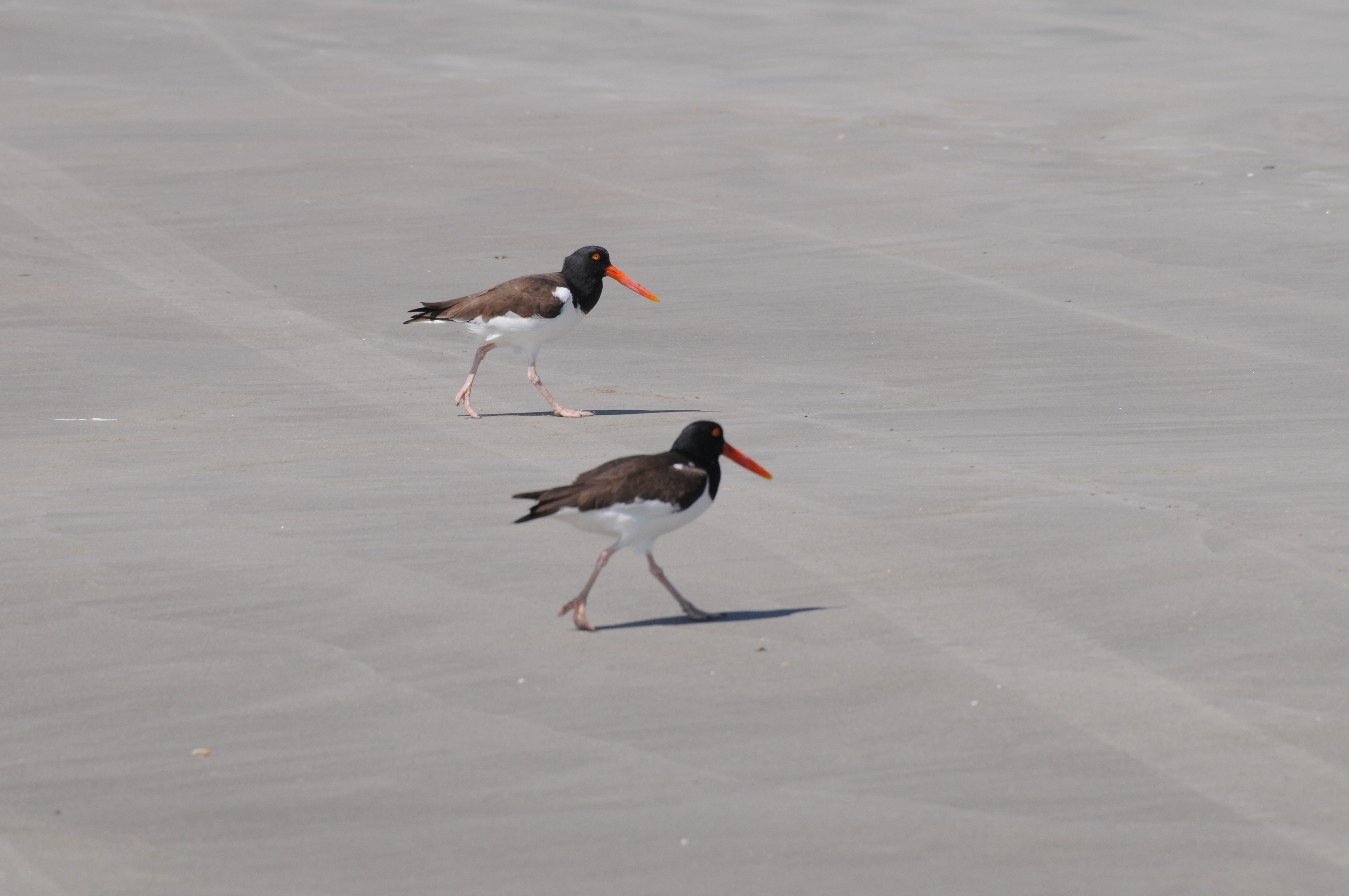
A pair of American Oystercatchers welcomed us to the beach on Kiawah Island, South Carolina, on a warm, sunny morning in mid March – a brief spring-break trip to the coast. They flew in close to where we were walking, announcing their arrival with lots of loud, clear, insistent whistles of queep-queep-queep-queedit-queedit that stood out as boldly as their colorful appearance.

The beach felt peaceful and quiet, with a big blue sky, wide stretch of sand, the tide about halfway in, a scattering of people, and the cushioning sound of the surf and the cries of gulls. Forster’s Terns – many of them – fluttered over the waves and flashed white in the sunlight, and Brown Pelicans sailed over the water further out. A few gray Willets waded in the rippled edge of the waves, and Ring-billed Gulls and Laughing Gulls flew over.

In one spot where the tide seemed to be coming in over a sandbar or maybe between two sandbars, a long pool of water had formed, and there must have been a good many fish trapped there. At least ten or fifteen Forster’s Terns were hovering, flickering, white and graceful, close together, low over the water and diving repeatedly here, strung out along the length of the pool. There were other shorebirds in this area, too – Willets, gulls probably, and maybe some sandpipers – but I was so fascinated by the terns that later I couldn’t remember for sure what else had been there. Some of the terns seemed to dive many times before catching a fish, even in such an easy spot.

Short-billed Dowitchers, Black-bellied Plover, Lesser Yellowlegs and Greater Yellowlegs

Thursday, March 17th, 2011

Further east along the beach, in a series of shallow lagoons and mud flats between the beach and a golf course, many sandpipers, wading birds, terns, gulls, and pelicans had gathered. It was the perfect place to practice shorebird identification – for me, an ongoing challenge and endless pleasure. Almost always, the behavior of a shorebird – the way it stands and moves and feeds, quick or deliberate, graceful or dowdy, alert, nervous or placid – identifies it even more quickly than its appearance. So many of them look alike – but their personalities are often vividly different.

Short-billed Dowitchers busily probed the shallow water, rarely lifting a round grayish head with its pale white eye-streak long enough to show the very long bill. A “Short-billed” Dowitcher’s bill is only short compared to a Long-billed Dowitcher. The two are very similar in appearance – stocky, sandpiper-like birds, in grayish barred and speckled winter plumage and typically very intent on probing steadily for food. Telling the difference between them is beyond my ability, unless I can hear their different calls – and these were all busy feeding, not coming and going, and not calling. I guessed Short-billed because they usually prefer beaches and mudflats like this – and checking a birding report by the Kiawah Island naturalist later confirmed they had been seen there.

Small, neat, snow-white and gray-backed Sanderlings, little Dunlins with their hunched postures and drooping bills, plump Red Knots and several long-legged Willets foraged in the shallow water, with a few Killdeer, one harlequin Ruddy Turnstone, and one watchful Black-bellied Plover that – as always – seemed to spend most of its time with its head held high, just looking around, darting in this direction and that, much less intent on feeding than most of the other birds, and giving the impression of keen awareness of its surroundings, and of the behaviors of all the other birds around – and of any approaching danger.

Meanwhile, three Lesser Yellowlegs stepped daintily in the shallow water very near the edge of one lagoon, and one Greater Yellowlegs foraged in the water nearby. Both are long-legged, slender, very active and a delight to watch – especially the slightly smaller and more delicate Lesser Yellowlegs. Like most shorebirds at this time of year, they were in grayish, almost nondescript winter plumage – but their long, spindly yellow legs are hard to miss. Both flew a short distance at different times, the Lesser Yellowlegs calling a sweet soft too-too, too-too, while the Greater Yellowlegs was louder and slightly rough, more zhreeoo-zhreeoo – I think this was their call usually described as tew, tew.

The Ringing Chatter of Semipalmated Plovers

Thursday, March 17th, 2011

Several Snowy Egrets fed together, spearing into the water with long thin bills, and lifting thin black legs to show a golden-yellow foot now and then. Three Brown Pelicans stood placidly in the pools.

A couple of Great Egrets, a Great Blue Heron and three or four Tri-colored Herons hunted in shallow water, and one pair of Buffleheads floated in the distance, small black and white ducks with big white patches on the sides of the head. Forster’s Terns hovered, shimmered and plunged into the water. Ospreys flew over on their way to and from the edge of the ocean. One Osprey bathed in a shallow pool. A mature Bald Eagle sailed directly overhead, silent, wings spread wide, white head and tail brilliant against a deep blue sky.

It seemed unreal, to be here like this. Each evening we watched the news on TV, and in the mornings, listened to NPR. An earthquake and tsunami had devastated Japan, and a nuclear crisis was beginning to unfold. Uprisings and conflict in the Middle East brought new chapters of change every day. And in the U.S. Congress, a painful, willful ignorance of reality seemed to prevail.

But here – four Semipalmated Plovers scurried around actively in the mudflats and sandy areas around the lagoons – and they were calling – a chirpy, chattery, rich series of varied whistles. I don’t think I’ve ever heard them calling like this before. They called several times, mostly as they flew from spot to spot – not while walking around and foraging.

An Osprey Nest on Kiawah

Thursday, March 17th, 2011

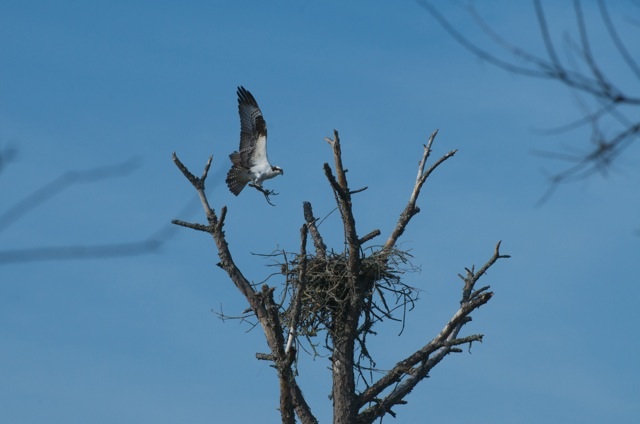
While we were on Kiawah in mid March, Ospreys seemed to be right in the middle of claiming and defending territories, often disputing claim to nest sites. So they were vocal and active, and we saw and heard them often.

This is one of five Osprey nests we saw, all easily visible from trails, bike paths or a road. This particular nest was in an area not far from a large home under construction, surrounded by woods and marsh, and the Osprey pair were coming and going, working on their nest despite a great deal of construction noise.

Flocks of Red Knots

Thursday, March 17th, 2011

Late in the afternoon on a sunny, warm day, a flock of Red Knots flew to a sandbar emerging as the tide went out, along the beach on Kiawah. They flew in a close, dense flock, moving as one, not directly, but fast and turning often, one way, then another, flashing white, then rosy brown, rising and falling, rippling and dipping, in fluid, symphonic motion that’s a joy to watch. It’s almost like watching thoughts or dreams in flight, showing brightness, shadows, certainty and doubt, fluctuating, settling, and rising again.

They approached from over the water, flew to the sandbar, touched briefly down – and flew back up – touched down – and flew up again, and finally settled on the sand, filtering down like leaves falling out of a wind. I’m not good at estimating numbers, but there were several hundred in the flock – a small flock compared to the huge gatherings of thousands of Red Knots observed in other places, especially in the Delaware Bay area each spring.

Red Knots are plump, rather large sandpipers with dark straight bills. Most of these were still in drab, grayish winter plumage, but a few showed a ruddy rash of red on the upper breast, starting to change into the robin-red breast, throat and face of spring. Maybe because this was near the end of day, they were not feeding as intently as usual. Several began bathing – stepping off the sandbar into shallow wavelets and dipping into the water, shaking, then stepping back onto the sand and preening.

A tapestry in motion, the hundreds of birds were almost dizzying to watch, with both birds and water around them moving. Shallow waves kept lapping in, gently breaking, rippling and flowing, and the knots themselves were in constant motion, some feeding, some bathing, some preening, some walking, some rising restlessly on wings, then settling back down, not flying, but never still.

Four or five Willets fed on the edges of the flock, while two Ring-billed Gulls stood stolidly among them, looking aloof and a little annoyed at all the bustling around them. I’m sure that’s not at all how they felt – who knows? – but that’s how they looked. And off the sandbar, at the edge of the waves near where I stood, a Ruddy Turnstone searched for food.

Red Knots are of particular concern because their population numbers appear to be decreasing dramatically. Known for making one of the longest annual migrations of any bird, Red Knots fly more than 9,000 miles from the Arctic to southern South America – almost 20,000 miles round trip each year. During these migrations, they concentrate in very large, dense flocks and depend heavily on food in traditional stopover areas, such as the Delaware Bay, where they feed on the eggs of horseshoe crabs during spring migration. Over-harvesting of horseshoe crabs is thought to be responsible, in part, for a severe decline in Red Knot populations, though there are also other threats to their survival.

“If recent trends continue, the eastern Red Knot will, by 2020, follow the Passenger Pigeon into the mists of memory,” writes ecologist and author Carl Safina, in his remarkable book, The View from Lazy Point, which I was reading in the evenings during our trip to Kiawah.*

Knowing that Red Knots are in this kind of peril makes seeing a flock like this even more amazing and special, and I watched them for a very long time before turning to go.

Walking back down the beach toward home, I passed several Sanderlings, a few Dunlins, four Semipalmated Plovers and one handsome Black-bellied Plover. Brown Pelicans and Forster’s Terns flew over the water.

Then – I came to one lone, solitary Red Knot, feeding at the edge of the surf, and I stopped to look at it closely and wonder if I was wrong about what it was – why would one Red Knot be alone? Why was it not with a flock? But it was undeniably a Red Knot, off on its own, a small puzzle – though it’s not the first time I’ve seen one alone like this, and maybe it’s really not unusual at all.

*Carl Safina, The View from Lazy Point, 2011, page 139.
Forster’s Terns

Thursday, March 17th, 2011

Late in the afternoon on a breezy day that had been mostly sunny, our last day on Kiawah, a part of the beach was shrouded in fog. The tide was high, and beginning to turn as I stepped off the boardwalk and headed east, into a sharp, cool wind. Forster’s Terns hovered, flashed white in the fog, and plunged into the water. Many Forster’s Terns. They were lined up, widely spaced, like airplanes waiting to land, just beyond the breaking waves, all along the edge of the surf where it was still deep enough for fish – and beyond that line was another and another – as far as I could see, more terns than I’ve ever seen at one time before. And although they were all in constant, flurried motion, altogether they formed an image, a whole, that seemed suspended in time. Facing into the wind, they hovered and plunged, over and over, seeming to keep a certain equal, constant amount of space among them. My whole view of the ocean was a foggy, mystical gray, dotted with the glistening white wings of terns over choppy waves.

As I walked, the fog lifted or maybe it drifted back down the beach, blown away by the wind, leaving sunshine and a big open blue sky again, and it became even more clear how very many terns there were, mostly Forster’s, beginning with a line along the edge of the waves, and more and more further out. I could easily count three dozen or more at a time – but have no estimate of how many there might have been in all.

A Forster’s Tern in flight is crisp, quick, very animated. Although I trust the Sibley Guide to Birds and its description that they are less graceful than Common Terns, I don’t have them both to compare – and in the winter months here, the Forster’s is, for me, a familiar delight. Its pale gray upper wings are edged with white that gleams and looks silvery. Like all terns, they are graceful flyers, with slender, pointed wings and long, trailing, deeply forked white-edged tails.

Several Laughing Gulls came flying together, sailing fast and low over the waves, almost skimming the water, flying toward the east. They were followed by another group of Laughing Gulls and another and another, maybe six, seven or eight together each time. A few Double-crested Cormorants swam in the water among the fishing terns, riding the swells of the waves, and disappearing under the surface when they dived. A scattering of Ring-billed Gulls and larger Herring Gulls stood on the sand. Sanderlings scurried along the rippled edge of the waves, and one small group of Sanderlings stood still, some preening, some resting on one leg – it seemed unusual to see the busy little sandpipers at rest. Four Semipalmated Plovers scurried around in the sand further away from the water.

I came to a group of a dozen or more Forster’s Terns standing on the beach, on the sand just at the edge of the tide, with the water sometimes rippling up over their feet and making them shift a little. They seemed to be gathering as the tide went out. More flew in as I watched, one or two at a time and the group gradually got larger. They stood facing into the wind, toward the east. Some preened. In spring plumage, Forster’s are medium-sized terns, mostly white with black caps, short orange legs and pointed orange bills with black tips. These terns were a mixture. A few still showed the black mask of winter plumage, though most had full or partial caps – some had a sort of speckled black nape. Some had orange and black bills, while others still looked all winter-black.

I watched them for several minutes as more and more flew in and settled into place among the group, and meanwhile, offshore, many other Forster’s Terns continued to sparkle as they hovered and plunged into the water.

Just before leaving, I took one last look at the terns standing on the beach, scanning my binoculars slowly over them – and came to four birds that looked huge among the others. Somehow I had missed their arrival. Four Royal Terns stood there, each with a long, thick golden orange bill, full jet-black cap that crests toward the back, snow-white plumage and short black legs. They looked like royalty indeed, big and solid and strong, the Forster’s suddenly diminutive in appearance around them.

Purple Finch Pair

Friday, March 11th, 2011

On a sunny, windy, chilly day, the rose-red blush of a male Purple Finch glowed among bare gray limbs. He was perched on a feeder in the front yard, with a brown and white streaked female on the same feeder just below him. The female’s bold white and brown face pattern – especially the big white stripe that arcs over the eye – and the short dark streaks on her breast were distinctive.

And the male’s color really is almost indescribable, hypnotic. A soft raspberry-red that spreads over head and back and throat and down the upper breast, with very little streaking on the sides at all, mostly smooth. The red feathers on the top of his head were slightly ruffled up.

The male leaned down and the female turned her head upward – but what I thought was going to be some kind of affectionate exchange turned into a snap and short lunge by the female – and he flew off to somewhere among the branches overhead, out of sight. The female stayed on the feeder for several minutes, eating and chasing away goldfinches and titmice that tried to join her. Then I noticed a second female Purple Finch on the other feeder in the yard. This is unusual – I have rarely seen them here. We have an abundance of House Finches in the neighborhood, year-round, but when a Purple Finch shows up, it’s a special occasion.

Later I saw a male and female Purple Finch again, this time perched close together in branches over the feeder, which was busy with goldfinches, titmice, chickadees, Chipping Sparrows, a Yellow-rumped Warbler and two Brown-headed Nuthatches coming and going.

A Cooper’s Hawk at Dusk

Thursday, March 10th, 2011

On another March day, earlier this week, by the time I got outside it was late, and the sun was low and almost hidden by yellow-gray clouds moving in from the west. Rain was expected for later that night and all the next day. The air felt warm and restless.

Around the feeders in our front yard were a pair of Pine Warblers, a pair of Downy Woodpeckers, a pair of Northern Cardinals, and two Carolina Chickadees that may or may not have been a male and female, but looked as if they were together. A gathering of couples. Several Chipping Sparrows also crowded the feeders, one White-throated Sparrow and a few Dark-eyed Juncos hunted on the ground, and dozens of American Robins were scattered all over the yard, in the grass and shrubs and trees. A Pine Warbler sang.

It had been a busy day, and my mind was often distracted as I walked, but now and then something called me back to the present. A Red-shouldered Hawk cried kee-yer repeatedly from somewhere beyond the woods toward the north, hidden by the trees.

The ti-ti-ti calls of two Golden-crowned Kinglets flitted around in the bare limbs of oaks and tulip poplars along one stretch of road where I almost always hear them recently. They were high in the trees, but I caught a glimpse of a black and white striped face, and a tiny flash of yellow crown. A Yellow-bellied Sapsucker mewed as it flew into a pecan tree nearby, at the top of a hill, and a break in the clouds let the sun come out, so the Sapsucker’s throat glowed like a ruby.

Just outside our neighborhood, through the noise of evening traffic on the highway below the old field, I could barely hear the calls of Eastern Towhees and the tseets of a few White-throated Sparrows, but not much else. Across the road from the field, I stopped at a corner to pay my respects at the spot where a large, almost black, thick-trunked oak had stood for many years. One of several large oaks – whose history I wish I knew – still standing in a neglected stretch of undeveloped land on the fringes of two subdivisions, this one had grown closest to the road. It looked like a tough, embattled old tree, with a sprawling, irregular cavity in its trunk and many other scars. Its largest limbs had already been cut back severely, so they looked like awkward stumps. It may have been diseased and dying, though last summer it still had leaves, and a Blue Grosbeak often perched in its branches to sing. I had recently noticed a red ribbon tied around its trunk, so I hadn’t been surprised to see a tree service truck and crew that morning, cutting it down. The only sign left of the old tree now was a soft, loose brown covering of wood chips where it used to grow.

I turned back toward home, and only a few steps down the road heard the rasping calls and one myeeur of a Gray Catbird – in almost exactly the same area of thicket and weeds where I saw one in late February, so maybe it’s the same. It hopped up into view – a long and slender bird, slate gray with a slim black cap – then flew further up to a low branch in another big old oak and perched there with its tail held high.

The sun went down, and clouds covered the sky, bringing an early twilight. When I got to the top of the last hill before turning back onto the road that leads to our house, I stopped and looked back down the hill. A smoke-gray shadow of a bird in the fading light, with spread wings and a long narrow tail, glided smoothly and fast, straight down over the road, and disappeared into the dense dark depths of a very big magnolia tree that stands in the middle of a large grass yard, as featureless and well-kept as a golf course.

Though I couldn’t see it well, I’m fairly sure it was a Cooper’s Hawk. Over the past few winters I’ve seen one slip into this tree at twilight several times. Disappearing like magic – like a falling star in the night – you’d never know it was there. Though the yard around it is open, the tree itself is thick with overlapping leaves, and across the road are many trees and shrubs, and woods beyond.