Gray Hairstreak

September 2nd, 2019

Later in the day, under a sunny, deep-blue sky, I went out looking for butterflies, but found many fewer than I’d hoped. I couldn’t find even one in our own yellow-blooming lantana, and on the edge of a neighbor’s yard – where five big mounds of orange and pink lantana grow more than five feet tall – there were only a few more. Some small Fiery Skippers, one flashy orange Gulf Fritillary, one Long-tailed Skipper with its smudged turquoise body. Along the old field, a scattering of lemon-yellow Cloudless Sulphurs fluttered over the weeds, and one Red-spotted Purple flew past me, flashing the iridescent-blue in its wings. But overall – distressingly few. 

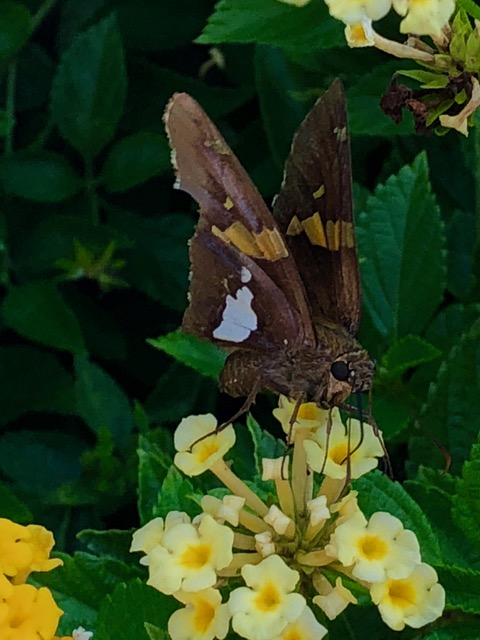
Back at home, I stopped to check out our lantana again, and at first saw only leaves and yellow flowers and one bumblebee – then one very small shape caught my eye, a stray glint of light. It was a tiny, silver-gray butterfly that used to be common here, but I haven’t seen in a very long time – a Gray Hairstreak. It was not very fluttery, and sat for long periods on each yellow bloom, with its wings folded up demurely, so I was able to kneel down and see it well.

At first glance almost insubstantial and plain in its twilight color, with a closer look, a Gray Hairstreak becomes a delight of intricate and colorful detail. The silver-gray wings are marked on the underside with dark, wavering patterns edged with white; the wing edges all around are finely lined with black and white. On the back edge of the wings, a patch of orange and black creates an eyespot. And tiny, threadlike “tails” extend from the wings, with small, round, bright-white tips. Together, the eyespot and the tails of a Gray Hairstreak create the illusion of a “head” that is thought to draw a predator’s attention away from the butterfly’s real head – so if it’s attacked, it might only lose a part of the back of its wings, and survive.

I watched for several minutes as it probed one bloom for a while, and then another, and another –rubbing its folded wings together in a way that made the wispy tails tremble – and finally fluttered away.  
Summer Tanager

September 2nd, 2019

The soft pik-a-tuk calls of a Summer Tanager moved through the leaves of the oaks around the edges of the yard. The sunny morning felt warm, but not yet hot. A Pine Warbler trilled its song, Ruby-throated Hummingbirds twittered as they flew from branches in the oaks to the feeder and back again, and off, chasing each other. A Carolina Wren sat on the deck rail and sang very loudly, its small body pulsing up and down with each phrase. An American Goldfinch called as it flew over, a Downy Woodpecker whinnied, a Red-tailed hawk screamed, over and over again, soaring somewhere near. An Eastern Towhee called chur-whee, and a Northern Cardinal peeped.

The Summer Tanager stayed deeply hidden in the foliage, its dry, ticking calls tracing its progress through the leaves, and I could only imagine how it looked as it moved, hunting for caterpillars and insects, maybe a bee or a wasp. A sturdy songbird with a rather large head and a long, thick bill, the male rose-red all over, the female deep, shadowy yellow.  

The morning felt peaceful and quiet on this Labor Day – no leaf blowers, no traffic sounds, at least not yet. Grasshoppers and crickets chirped, and a few cicadas raised their songs, but not many. Carolina Chickadees and Tufted Titmice chattered in the woods. It felt good to be home, as always, after ten days away, even though we enjoyed the trip. I felt surrounded and bathed in green leaves, with trees all around me. 

All is not well with the world. Not at all. Climate change looms and grows worse every day – and yet we fail to pay attention, we fail to do what must be done. Birds, bees, butterflies and frogs, forests and oceans are dying, glaciers melt, and not a day goes by when I do not struggle to think what more we can do, what more I might do. And how.

And I have no answers that are new. Some days it seems the best I can do is to pay attention. To notice the Summer Tanager’s soft call, and the song of a Carolina Wren. To continue taking note of what is here, as well as what’s not.

Scarlet Tanager Calls

July 22nd, 2019

Early this afternoon, I heard the repeated chik-brrr calls of a Scarlet Tanager in the dense leaves of trees and bushes on the eastern edge of our yard. The calls are sharp and distinctive, with a faintly buzzy quality that feels almost electric. Sometimes it’s just the chik call, repeated several times, and then it returns to chik-brrr. Though quiet and unobtrusive, the calls are so expressive it’s easy to imagine the birds, maybe a pair, calling back and forth to each other as they move, unseen, through the leaves of the woods. 

The Scarlet Tanager’s call is one of the best examples of how helpful it is to recognize birds by ear because – despite its brilliant red and black colors – a Scarlet Tanager can be frustratingly hard to see. It’s a bird that prefers deep woods and stays most often hidden in the higher, leafiest parts of the trees. I hear them many times more often than I see them – though to see one is always amazing. A male Scarlet Tanager is a medium-size songbird, bright red, with contrasting black wings and tail. The female is beautiful in her own way, much more subdued in color, olive-yellow with shadowy, darker wings and tail. 

A Scarlet Tanager’s call might actually be considered more appealing than its song, which is often described as sounding like a robin with a sore throat – a series of several phrases that rise and fall, with notes that sound harsh or awkward. It lacks the more musical quality of a robin’s song – or the smoother, lilting song of its close relative, a Summer Tanager. 

A Scarlet Tanager sang in the woods beyond our back yard from May 5 of this year through all of June. It made a steady circuit through the trees each day, following the same pattern, beginning very early in the mornings, most of the time staying pretty far away. Sometimes it came quite close, but I never succeeded in seeing it. At some point, it fell quiet, and I haven’t heard its song now since July 2. So these calls are a welcome sign that at least one, and maybe more are still close around.  

Scarlet Tanagers are long-distance neotropical migrants that spend summers in the deciduous forests of eastern North America, and winters in northwestern South America. They depend on large areas of hardwood forest for breeding and nesting, and are considered very sensitive to forest fragmentation. For this reason, there is some concern for their future. 

In places like the woods that surround our neighborhood – patchy, second-growth woodlands that can’t be described as forest, really – Scarlet Tanagers often suffer greatly from predators and parasitism. On the other hand – given the loss of so much forested land in recent decades, it may be that places like these woods can offer precarious, but much-needed refuge. I do not know if the Scarlet Tanagers I’ve heard have nested successfully. I can only hope.

Much later in the afternoon today, I heard the chik-brrr calls again, in the middle of a small thundershower, coming from the same leafy area, not far from my office windows. Along with the sweet rush of a summer rain and the soft rumble of thunder – some of summer’s most happy sounds. 

Fiery Skipper and Silver-spotted Skipper Butterflies

July 16th, 2019
Silver-spotted Skipper

This morning our yellow blooms of lantana had come to life with a fluttering burst of several Fiery Skipper butterflies, and with them, one larger Silver-spotted Skipper.

The Fiery Skippers are very small orange and brown or black butterflies that – when they’re not fluttering from bloom to bloom – often hold their wings in a kind of triangle shape, with the forewings held upright, and the hindwings folded flat. At first glance, they appear kind of plain, even drab, but a closer look shows big black eyes in a fuzzy face that’s very appealing. I watched several probing individual yellow blooms with long, thread-like black proboscis. Their short antennae have tiny orange clubs on the ends. 

The Silver-spotted Skipper is larger, but with a similar shape. It’s a much darker brown, with a prominent silver-white band on the underside of its hindwings. 

In doing some research about them – because I know very little about butterflies, but would like to learn – I found one source that said Silver-spotted Skippers almost never visit yellow flowers – but this one was visiting yellow lantana blooms, and I have often seen them in past years in our lantana. Maybe it’s not their first choice – maybe they have few choices here.

Where Have All the Butterflies Gone?

July 13th, 2019

A column by Charles Seabrook in today’s Atlanta Journal-Constitution, “Where Are the Butterflies?” notes that a number of observers in Atlanta and other areas of Georgia have noticed a scarcity of butterflies this summer. I read the column with great interest, because around our home in Oconee County I have seen very few butterflies this year – and their absence is stunning.

Specific reasons for the low numbers are not yet clear, Seabrook writes, and might include something like this year’s very wet spring. However, there is growing concern worldwide for the future of butterflies and moths, and a number of studies have begun to document alarming declines. Widespread use of pesticides, habitat loss, climate change and other factors threaten butterflies – and many insect species. 

I started to notice a decline in butterfly numbers here about three or four years ago, but this year there are the fewest yet. And it’s not only that we see fewer in number, but there also are several species that seem to have completely disappeared – at least here, in this one place. At the same time, I have suddenly become aware that we’re seeing far, far fewer moths than we used to see at night. 

We have taken them so much for granted, these ephemeral gifts of impossible beauty – in our yards, along the roadsides, in towns and gardens and thickets and weeds. Tiger Swallowtail, Black Swallowtail, Red-spotted Purple, Buckeye, Gulf Fritillary, Fiery Skipper, Silver-spotted Skipper, Clouded Sulphur, Sleepy Orange, American Painted Lady, Red Admiral, Little Wood Satyr, Eastern Tailed Blue, Gray Hairstreak, Blue Azure, Mourning Cloak, Monarch, Viceroy – these are some of the butterflies we’ve seen just here in our own neighborhood over the past 19 years. And now? Many seem to be gone.

I remember standing one enchanting summer afternoon along a roadside – six years ago – in a shady spot near the woods, and watching two Little Wood Satyrs flit among the brown stems of weeds and grasses – small, moth-brown butterflies with wings patterned in soft, intricate shades and scalloped lines of brown, tan, and taupe, and several large dark eye-spots ringed in yellow around the edges of the wings. They paused to rest in the grass, sometimes with wings spread, and sometimes with wings held up, then fluttered up again but did not fly away or fly far, staying around this small spot for several minutes. It was like watching fairies dance. 

It is heartbreaking to realize that we are in serious danger of losing the beauty and magic of butterflies and moths in our lives. Scientists are doing important studies, and more is being learned, but I’m afraid most people simply don’t realize what’s happening – or how fast.

Blue Grosbeak, Indigo Bunting and Gray Catbird

July 1st, 2019

By mid-morning the sun felt very hot, bleaching the sky as it climbed. Chipping Sparrows trilled their songs from trees along the roadside. Mourning Doves cooed. Three Chimney Swifts twittered as they flew over and swooped down close to a roof. As I walked down the road, I heard a scattering of calls from the usual suspects – a few Carolina Chickadees, Tufted Titmice, several Carolina Wrens, two Brown-headed Nuthatches, a White-breasted Nuthatch, Red-bellied Woodpecker, a Northern Mockingbird and several House Wrens and House Finches singing, and many Eastern Bluebirds, some sitting in the tops of trees, facing the morning sun. I didn’t hear a single Red-eyed Vireo – one of our summer birds that used to be so common here, but now I seldom find. But one Yellow-throated Vireo was singing high up in the foliage of trees around the edge of a neighbor’s yard. They, too, have become much less common here, so it’s been good to hear this one’s mellow, burry phrases for the past several days.

In the hazy, blue and white sky, two Mississippi Kites seemed to appear out of nowhere. They were high, but not too high to see well – the smooth gray color, and ash-white head, and white in part of the long, gray wings. I watched as they circled several times, gradually climbing, watching their quiet, graceful flight, the clean, sharp lines, the tilt of the dark, fanned tail just as one passed low over my head. Sailing, gliding, buoyant – they rose higher and higher, and finally soared away toward the South, over the trees and out of sight. 

When I came to the entrance of our subdivision, oh my! A Blue Grosbeak sat in the very top of a tall pecan tree, singing. A richly colorful bird with a richly colorful song – deep, ink-blue, with orange-brown bars in the wings and a big silver bill that glinted in the sun, the Grosbeak lifted its head and warbled a shining cascade of notes that rose and fell. 

Just across the road, in the large, overgrown old field that hides the view – though not the sound – of a busy highway below, a tiny Indigo Bunting also sang. Perched in the top of one of the tallest pines on one side of a power cut, the small, bird-shaped dot of brilliant blue chanted its sweet-sweet-chew-chew-sweet-sweet over and over again. Apparently undaunted by the constant growling roar of traffic. 

Two White-eyed Vireos repeated chik-per-chickory-chik in the field from hidden spots deep in the thickets, along with the notes of Eastern Towhees, Carolina Wrens, and a Northern Mockingbird sitting on a wire. A sparkling, silvery Blue-gray Gnatcatcher flitted and hovered in and out of the weeds, catching insects. And a little further on, on a street of neatly-manicured lawns and shrubs, a Gray Catbird mewed a raspy call from among the leaves of a large crape myrtle, where I saw its slender, dark-gray shape and long, jaunty tail just briefly before it flew and disappeared into a Leyland cypress tree.

Early Morning on a Summer Day

July 1st, 2019

Soon after sunrise this morning, the day already felt very warm. The sky was still a gentle blue with scattered, small white clouds. From somewhere in the woods around our back yard, a Pine Warbler trilled a cool and shady song. Two Eastern Towhees called back and forth, chur-whee, one on either side of the yard. A Summer Tanager sang from trees around the edge of the woods, and from further away, I could also hear the more strident notes of a Scarlet Tanager. An Acadian Flycatcher sang its sharp but quiet pit-sah! from down around the creek. A Great Crested Flycatcher whistled a burry whreep – and another answered. 

An Eastern Bluebird pair made frequent trips to and from a nest box, feeding babies that cheeped loudly each time a parent arrived. Ruby-throated Hummingbirds zipped often to the feeder that hangs from the deck. A Chipping Sparrow sang a long, level trill; Carolina Wrens burbled, fussed, and sang. A Tufted Titmouse piped peter-peter. A Downy Woodpecker whinnied. An American Goldfinch flew over, and I could hear the distant caws of American Crows, as well as the muffled noise of morning traffic. 

The long, percussive ka-ka-ka-ka-ka-cawp-cawp-cawp-cawp of a Yellow-billed Cuckoo echoed through the trees from pretty far away. Even though it rarely comes close, I’m happy to hear a Yellow-billed Cuckoo at all, because it’s the only one I’ve found around our whole neighborhood so far this summer. Sometimes the distant songs and calls of once-familiar birds like the Cuckoo, the Scarlet Tanager, and the Wood Thrush we hear now and then, sound like birds that are fading away, not a sudden disappearance, but drifting further and further away each year. 

Mississippi Kite in Flight

June 30th, 2019

Just a few days later, I watched another Mississippi Kite. It was a hot, humid, sunny summer morning, with cicadas singing loudly and small insects swarming in shafts of light. The sleek, dark raptor with long, pointed wings appeared in a soft blue sky. Its shape and flight were so neat and crisp they might have been drawn in ink against the sky. 

For several minutes, it circled directly above me, slowly rising higher, and I watched the whole time, only turning away when it flew right across the path of the sun. It was absolutely glorious to watch – its cool, dark gray and shining near-white pattern cutting through the hazy air with such cool grace. 

I watched as it sailed in large circles, floated in the air, and once it appeared to lean over to eat something from its talons. After several minutes, it had climbed a little higher and I thought it was going to keep climbing and maybe sail away, but instead, it suddenly plunged down fast, from fairly high, directly down, and disappeared behind some distant trees. I waited for a few minutes more, but it didn’t reappear.

Like the essence of summer in flight, a Mississippi Kite was a beautiful note on which to end this month of June. 

Mississippi Kite

June 26th, 2019

Mid-morning on this warm, rather quiet summer day, a dark, slender phantom of a bird, with flashes of ghost-white in its wings flew low out of trees on one side of a neighborhood road, and disappeared into trees behind houses on the other side. I stopped to watch, and after only a few moments, it flew again, emerging from one spot in the trees and flying to another – and then much deeper into the woods. Though it was only a very brief look, it was enough to see the distinctive near-white head and dark gray color and shape of a Mississippi Kite. 

I wasn’t expecting to see a Mississippi Kite here, in the middle of a neighborhood of neat green lawns and manicured landscapes, where mockingbirds, cardinals and towhees are more common. An elegant raptor known for its graceful, acrobatic flight over sunny fields and pastures, the kite felt like a very exotic visitor down here in the shadows of these suburban oaks and pines. And yet, this isn’t the first time I’ve seen one here this summer. 

Mississippi Kites are still relatively uncommon in this part of Georgia, though over the past few years they seem to be reported more often, and in our own neighborhood, I’ve been seeing one or two fairly often this summer. I can’t say for sure that a pair is nesting here, but I see them most often around one particular wooded area near a creek, sometimes perched in a tree and sometimes in flight. They are only here in the summer months, and spend winters in central South America. 

In some regions of North America, like the southern Great Plains, Mississippi Kites are much more common and even abundant. They frequently nest in large colonies and often in urban areas. East of the Mississippi, where they are found in several southern states, including Georgia, they are much less abundant, and nest most often in old-growth forest. 

A Mississippi Kite is a slender raptor with long pointed wings and a long, square-tipped tail. It is pale gray below and darker gray above, with a very pale head that looks almost white, and white in part of the dark-gray wings. The wingtips and tail are black. When it’s soaring high, it often appears all dark, even black, but when it’s low enough the gray color and pattern becomes apparent, and the head glows white in the sun.

Known for their acrobatic, buoyant flight, Mississippi Kites are a joy to watch as they circle, dive, turn, and swoop, catching large flying insects in their talons and often eating them as they fly. 

Winter Morning Birdsong

February 7th, 2019

This morning would have been a lovely day in April or May. But in early February, it didn’t feel right. After a few cold, crisp days to begin the month, the weather has now turned unseasonably warm. The air drifting through my open windows between 7:00 and 8:00 felt soft and balmy, and birds filled the morning with song. Pine Warbler, Carolina Wren, Eastern Towhee, Eastern Bluebird, Tufted Titmouse, and Carolina Chickadee all were singing. Ruby-crowned Kinglet, Brown-headed Nuthatch, American Goldfinch, and Downy Woodpecker called. A Red-bellied Woodpecker purred its spring-like quurrr. A Mockingbird squawked harshly, and Northern Cardinals peeped. American Crows cawed, and a flock of blackbirds scattered their calls as they flew over. A Mourning Dove cooed.

By afternoon on a sunny day, the temperature had risen to 80 degrees.