Red-winged Blackbirds

January 15th, 2014

On a chilly, sunny morning, a Black Vulture sailed across a deep blue sky, quilted with high white clouds. The white patches in the wings of the vulture flashed, and its silent flight reflected the quiet of the landscape all around. Even though it was such a beautiful day, few birds were active here, at least when I was out. A Carolina Wren was singing. Crows quietly walked across yards. A few American Robins foraged in other yards, here and there. The dry chatter of a Chickadee or two, a Titmouse, a Red-bellied Woodpecker came from the woods. An Eastern Phoebe hovered above a tangle of withered vines around a mailbox. Not even Bluebirds or Chipping Sparrows seemed to be out and about.

Then at the crest of a hill, I began to hear the conk-a-ree calls of Red-winged Blackbirds and rusty creaking calls of Common Grackles, and saw a Blackbird flock settled mostly in a patch of scrappy oaks and pines not far in the distance, but too far to see very well, especially against a very bright sky. It was not a large flock – maybe a hundred or two, as well as I could tell, a very rough guess – but it’s the most blackbirds I’ve seen coming into the neighborhood so far this season.

After the Storms – Dark-eyed Juncos in Sunlit Pines

January 11th, 2014

Overnight a foggy, misty rain became a showering rain, and then about 3:00 am, close, frequent lightning, thunder, wind and heavy rain arrived and continued for several hours – the worst thunderstorms we’ve had here in a long time. Even after the lightning and thunder had passed, a hard, steady, heavy rain continued to pour down all morning and into the early afternoon.

Sometime around mid-afternoon the rain stopped, and within an hour or two, the clouds had all gone, leaving behind a weakly shining sun in a pale, washed-out blue sky, as if even it were water-logged. The all-night, all-morning deluge left our world here drenched, soggy, and streaming with water everywhere – in roadside ditches, gullies, and down sloping yards water flowed. Pools of water stood in flat depressions. Bushes and evergreens sagged with the weight of wet leaves. Both the creeks down in the woods rushed loudly with torrents of water.

As I walked along the road with the edge of the woods on one side, I heard the high, whispery twittering calls of Dark-eyed Juncos and stopped to look, and to see what else might be with them. Several Juncos were in the trees, both hardwoods and pines, along with a few Chickadees, Titmice, Carolina Wrens and a Downy Woodpecker.

Two Dark-eyed Juncos perched high up in the green needles of a sunlit pine. The light touched the soft, powder-gray of their plumage with tiny glints of color, and with their round heads, pink bills, white bellies and twittering chatter, they looked and sounded gentle and peaceful, a welcome scene after the hours of violent storms and torrential rain.

Otherwise, there were only a few birds out and about – Eastern Bluebird, Eastern Towhee, House Finch, a scattering of American Robins, a White-breasted Nuthatch, Northern Flicker, Red-bellied Woodpecker, one Yellow-bellied Sapsucker, White-throated Sparrows, Eastern Phoebe – and a stunning Red-shouldered Hawk that flew low over housetops and into a line of trees, looking deep rose-brown in the lowering sun.

As the sun began to set, a waxing gibbous moon shined bright straight overhead, and several large flocks of blackbirds began to fly over, mostly Common Grackles, but also others that I couldn’t identify for sure. One flock after another streamed over, calling as they flew, all heading north, maybe 1,000 blackbirds in all – a conservative estimate, I think.

This was the most blackbirds I’ve seen this winter, and these were just flying over, not stopping. So far this year I have not seen the large blackbird flocks that have been regular visitors here in our neighborhood the past few years, often congregating and moving through yards and trees. So the winter seems pretty quiet here without them.

Red-shouldered Hawk

January 9th, 2014

The first few days of January have been cold and often windy. When I got back home after a walk late this morning – on another gray, cloudy, chilly day – I was surprised to see the back of a big, vividly-colored Red-shouldered Hawk sitting on top of the bluebird house in our front yard, not far away from where I stood. It was facing away from me – the dark-brown back checkered with black and white, the red shoulders showing up especially well, and the black-and-white banded tail. For one good moment, the view was perfect – then it turned its head toward me, spread its wings and swept low across the yard and up into a tree along the driveway. There it sat on a low branch, again with its back toward me. In more shadows now, its colors looked a more subdued brown and orange, but the reddish shoulders still glowed, and its large head showed feathers of a dark reddish-brown.

It probably was watching for the chipmunks that live around the house, since small mammals are a Red-shouldered Hawk’s most common prey, along with other small animals like lizards, frogs and snakes. Although they do sometimes take small birds that come to feeders like the one in our yard, I can’t mind having it around. We’re very lucky to have them here in our neighborhood, and to see them fairly often.

Red-shouldered Hawks are still relatively widespread, but their populations have declined considerably in many areas of the Eastern U.S. They are woodland raptors, most at home in a deep forest of some size, though they also can be found in suburban areas where enough large trees remain. The greatest threat to Red-shouldered Hawks is continued clearing of their wooded habitat.*

I walked slowly down the driveway, trying not to disturb the hawk again, and when I went up the front steps and into the house, it had not flown and was still sitting in the same tree.

* The Cornell Lab of Ornithology, All About Birds

Ruby-crowned Kinglet and White-breasted Nuthatch

January 1st, 2014

As the sun rose this morning, on the first day of the New Year, layers of gray clouds blanketed the sky and the horizon, and the only signs of color were pale ribbons of yellow that soon faded. But a Carolina Wren sang a bright and optimistic song.

The whole day remained cloudy and gray, and when I first stepped outside for a walk around the middle of the afternoon, it seemed there were no birds at all in the yard or anywhere near, only stillness and cold and quiet.

It was a day in which individual sounds and movements stood out against a hushed background. At first there were only a few anonymous chips and peeps. Gradually the usual suspects showed up, though not many in any one place. The chatter and fussing of Carolina Chickadee and Tufted Titmouse; the calls of a Red-bellied Woodpecker and a Downy Woodpecker from somewhere in the woods; the song of a Carolina Wren and peeping of a Northern Cardinal from a hedge of shrubs. A Yellow-rumped Warbler flew here, another there, scattering emphatic chips as they flew. Two Eastern Bluebirds and several Chipping Sparrows flushed up from the grass along the roadside.

From down the road I heard the squeaky chatter of a Brown-headed Nuthatch. The white patch on the rump of a Northern Flicker flashed as it flew across the road and into some trees in a thicket of vines and shrubs. A tiny, round feathered ball of energy hurtled into the same weedy bushes, chattering a dry, ruffled jidit-jidit – a Ruby-crowned Kinglet, the first bird close enough to see clearly and watch. A neat gray-green little bird with sharp white wing bars and a white ring around the eye, it flitted quickly from spot to spot, flicking its wings and gleaning something from the drab leaves and branches of the privet. Its ruby-red crown was hidden so the head looked smooth and gray.

A little further up the road, a solitary and silent White-breasted Nuthatch crept down the trunk of a pecan tree, its back a clean blue-gray, its crown ink-black, its throat and face snow-white. The high, thin calls of Golden-crowned Kinglets – ti-ti-ti – whispered in the treetops, but the light was too gray and they were too high up for me to see anything but little birds moving very quickly over the branches. A few more Yellow-rumped Warblers flew from tree to tree, and a Yellow-bellied Sapsucker mewed clearly several times.

Around the wooded yard where the young Red-headed Woodpecker seems to be spending the winter, I heard its churry, rolling calls again, and saw it briefly on the broken-off standing-dead remnant of an oak that it seems to like best.

The harsh squawk of a Northern Mockingbird, the chur-wheee of an Eastern Towhee, the cries of Blue Jays now and then broke the quiet. Six American Crows flew over and cawed. In one large yard, a very small flock of Blackbirds foraged in the short brown grass under bare-limbed trees. Among them were a few Common Grackles, and others that may have been Red-winged or Rusty Blackbirds, but I was too far away to see them well.

A Red-tailed Hawk sat on top of a pole overlooking the highway below, and in the tall brown grass and weeds of the old field by the highway, as trucks and cars rushed by, one White-throated Sparrow sang.

Northern Harrier

December 31st, 2013

After a cloudy, gray day, the sun set tonight with very little color, only the faintest pale peach among the pale clouds, no fireworks in the sky to mark this last day of the year, just a quiet sinking, and swift fading of light into dark.

The most memorable part of the day for me, in the end, was watching a Northern Harrier fly low over fields beside a road on my way to the grocery store. It was clear enough to identify, but never close enough to see really well, remaining just a little too far in the distance. Though we used to see them often in the winter, a Northern Harrier is a much less common sight now, so I pulled to the side of the road to watch. There was almost no traffic on this road at the time, though other, nearby roads were busy. The Harrier appeared to be gray, and it flew low over the fields, flapping its long wings often, then sailing low, a large, slender, graceful gray bird against a murky gray sky. It never came very close, and steadily moved further away until it moved out of sight.

Even though it wasn’t a close or dramatic sighting, seeing the Northern Harrier seemed a beautiful way to end the year. I could see it as a ghostly, shadowy bird, because in truth, Harriers may be fading into the past, along with so many other birds of open places. Though populations of Northern Harriers are still widespread in North America, numbers have been declining for several decades, mainly because of habitat loss.

Or I might see it as a hopeful sign, that even with all the changes here, the steady loss of wetlands, fields and pastures to more development, more roads, more traffic – still there is a Northern Harrier flying over a field of withered stubble and grass and weeds, and it was wild and beautiful to watch.

Red-headed Woodpecker

December 31st, 2013

While walking past a wooded yard of mostly hardwoods, along the lowest part of the road near a creek, I heard the rolling, churry calls of a Red-headed Woodpecker. I first discovered it here much earlier in the month, December 4. Even before that, I’d been hearing its calls for a couple of weeks or more, but had not been able to see it, and so I wasn’t sure. But this time I was finally able to get a good look. It was a juvenile Red-headed Woodpecker – with brown head, a white breast with blurry streaks, and black wings with broad white wing patches marked with some black. It was very vocal and active, calling often as it flew from tree to tree and back again in the same area, and returning again and again to one particular slender, broken-off, standing dead oak that was riddled with woodpecker holes and peeling bark.

Since that day early in the month, though I haven’t been out often, almost every time I’ve come by this spot, the juvenile Red-headed Woodpecker has been here, calling and flying restlessly from tree to tree. Once I watched as a Northern Flicker flew from across the road into the area of trees around the standing dead oak – and a very agitated Red-headed Woodpecker immediately chased it away.

Today, though I could hear its rolling chortle and could tell it was moving around from tree to tree, I could not spot it, mostly because of the gray light and also because it seemed to be close to the house and I don’t like to point binoculars or stare directly at neighbors’ homes for too long. So after a few minutes of just listening and watching for its movement, I walked on, deciding it was nice enough to know that it’s here.

Winter Birds

December 31st, 2013

Most of the month of December this year has been too busy for me to be outside, or even to stop to notice the birds around our house – and that’s way too busy, I know. But it was an unusual time.

A late-afternoon walk today, the last day of the year, was cloudy and gray like so many other days lately, but outside it didn’t seem gloomy. The light was a clear gray, and the clouds were high, layered, curled, and varied, the kind of winter sky in which there seems no end to the variations in shape and shade of the clouds, even though they’re all gray – milky, gray-white, pewter, silver, slate, smoke, pearl, dusky, taupe, blue-gray, ash, and streaks of charcoal.

It was chilly and damp, in the low 40s, and a slight breeze felt sharp and good. As I stepped out the front door, a Carolina Chickadee chattered, and an Eastern Towhee called a rich chur-wheee. The hard, sibilant tseeeeets of White-throated Sparrows came from the dark leaves of wax myrtles and hollies. A young Yellow-bellied Sapsucker, its markings muted and mottled brown and black like tree-bark, showing only the faintest hint of red in the crown, worked quietly on the trunk and large limbs of a pecan tree. Dark-eyed Juncos twittered in high, soft, nervous tones in the trees.

In thickets around the first corner I came to, a Ruby-crowned Kinglet chattered its dry jidit-jidit. Down the street and around the corner, birds seemed mostly quiet at first – only the peeps of Northern Cardinals, and the pink of a Downy Woodpecker, and isolated other calls from somewhere in the patchy trees – the rattle of a Red-bellied Woodpecker, the fussing of a Tufted Titmouse. Somewhere an Eastern Phoebe sang, one Carolina Wren trilled and another sang. Several Eastern Bluebirds, Yellow-rumped Warblers and Chipping Sparrows foraged in a grassy yard, scattering up into low branches as I walked by, with dry flicks and chips. A Pileated Woodpecker called its kuk-kuk-kuk traveling call from down in the woods.

A little further up the road I heard a lot of chattering and found a feeding flock that included at least four, and I think six Brown-headed Nuthatches in the pines and hardwoods along the roadside. I’ve rarely seen so many Brown-headed Nuthatches together. With them were Carolina Chickadees, a Yellow-bellied Sapsucker mewing several times, Yellow-rumped Warblers, Carolina Wren, Eastern Phoebe, Red-bellied Woodpecker, Downy Woodpecker, and Tufted Titmice.

After watching them all for a while, I walked on up the hill, and around the crest of the hill, near a heavily wooded yard, I listened and watched for the Hermit Thrush I’ve sometimes found here, but there was no sign of it, no soft, liquid chup.

Two small flocks of quiet Blackbirds flew over, at least a few Common Grackles among them. Further on, a much smaller and faster flock of other birds that at first looked like Cedar Waxwings flew across the sky ahead of me, well above the treetops. Then this flock was followed quickly by another, much larger flock of 100 or more birds that looked about the same, and so I don’t know for sure what they were. They didn’t fly like Starlings or Blackbirds or Robins – so I don’t know. It was that kind of day, gray and now-fading light, with mostly quiet flocks of dark birds fleeing toward the west, like words I couldn’t quite hear, or fragments of a dream, or moments almost grasped, but lost.

Meanwhile, a White-throated Sparrow whistled its plaintive song from a yard of mixed shrubs and tall, brown grasses, especially sweet in the lovely, winter-gray quiet of late day.
Reddish Egret

December 22nd, 2013

On a cloudy, breezy day in September eleven years ago, on a walk with my father in Pinckney Island National Wildlife Refuge, we watched a beautiful young Reddish Egret for several minutes. Unfortunately, I don’t have any photographs from that day, but the memory remains vivid, and my journal account from the time describes what we saw.

It was late in the morning, muggy and warm, but not hot. Several dozen White Ibis were feeding in the marshes, a few rising up in flight from time to time, and around the Ibis Pond we passed three juvenile Little Blue Herons perched like white flowers blooming in the dense growth of trees and other vegetation around the pond.

We had not gone far past the pond when I saw a pale, grayish egret standing in the middle of the wide, grassy roadway that formed the trail through the refuge. We stopped to get a better look when the bird was only about 20 yards away from us, maybe less – it was a first-year juvenile Reddish Egret. At first, my father kept walking toward it, and I was sure it would fly at any moment, but it did not. It seemed unperturbed. So we were both able to watch it at very close range for several minutes, a slender, long-legged, long-necked bird with a long, heavy, pointed bill – and even my father, who was not a serious birder and was usually impatient to walk on, was fascinated by the Reddish Egret’s uncommon beauty and entertaining behavior.

One of the things I remember best is its ethereal coloring – a soft, pale gray and rosy-brown. The Sibley Guide to Birds describes the wings of a first-year juvenile as a “unique pale, chalky color,” and this is what it looked like, almost dove-like, but more lovely than words can express. A reddish hint along the folded wing was particularly noticeable.

Finally, we came close enough so that the heron moved away, but still it didn’t fly. It just spread out its wings and walked into the marsh grass and shallow water beside the road, still not far away. There, it immediately started to search for food, opening its wings, hopping and stabbing at the water in its distinctive, unique feeding behavior, almost like dancing. We watched for several minutes more, then walked on. It was a memorable sighting – I could not have asked for a closer, more vivid look at a young Reddish Egret.

A Tribute to My Father – With Memories of Walks and Birds

December 22nd, 2013

On December 11 my father, Robert Gayvert, passed away, at the age of 94. He lived a full and fortunate life, as much as anyone could ask, but I will miss him. His love of gardening, especially flowers and flowering shrubs and trees – roses, gladiolas, lilies, azaleas, dogwoods, redbuds and many more – gave him the greatest pleasure, and is one of the greatest gifts he left to his children, grandchildren and great-grandchildren. Even though he never insisted on any of us sharing in his gardening work, we all picked it up in different ways. For myself, his influence had more than a little to do with my own early interest in organic vegetable gardening – which led me over time to a greater interest in all of the natural world – and to birds.

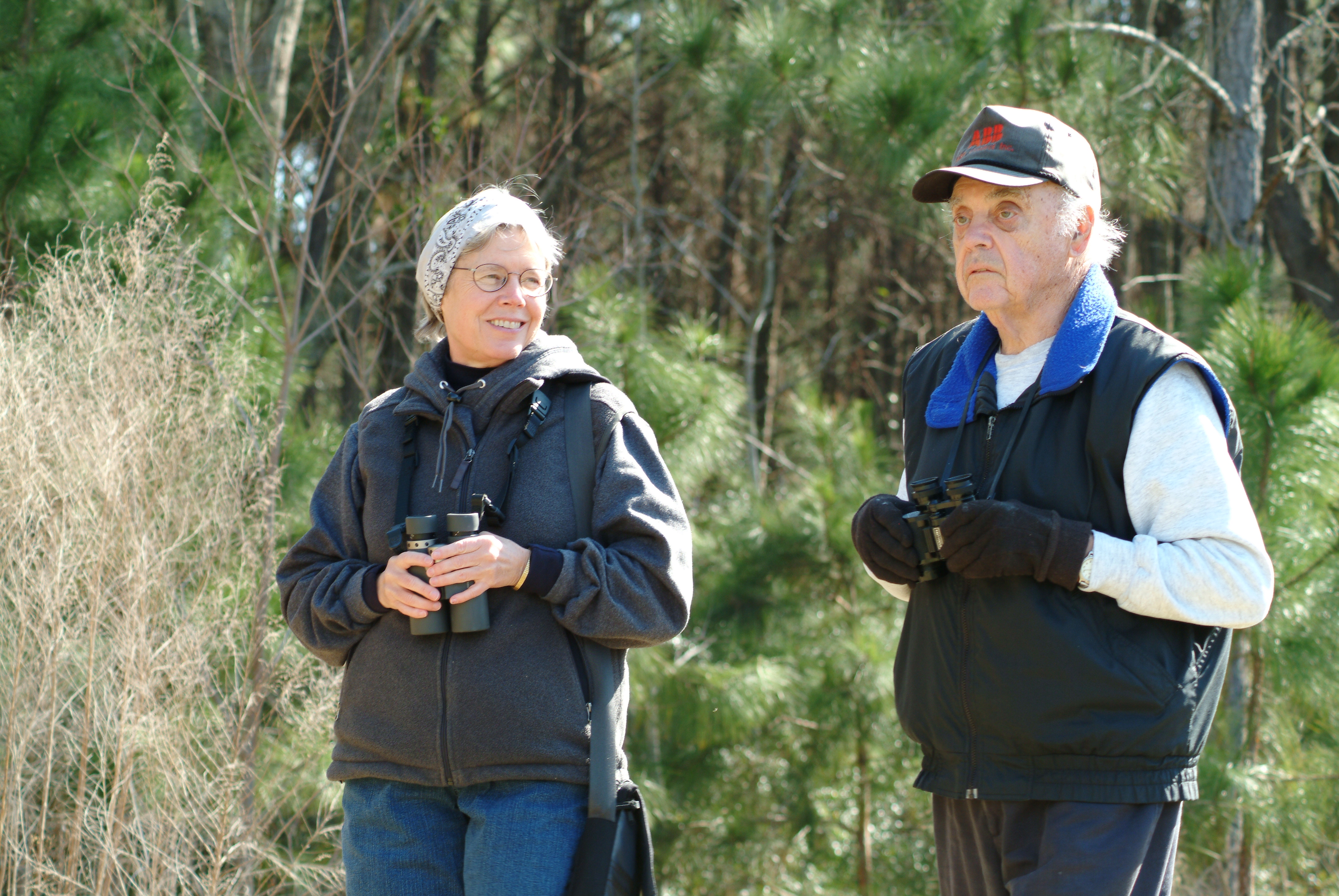
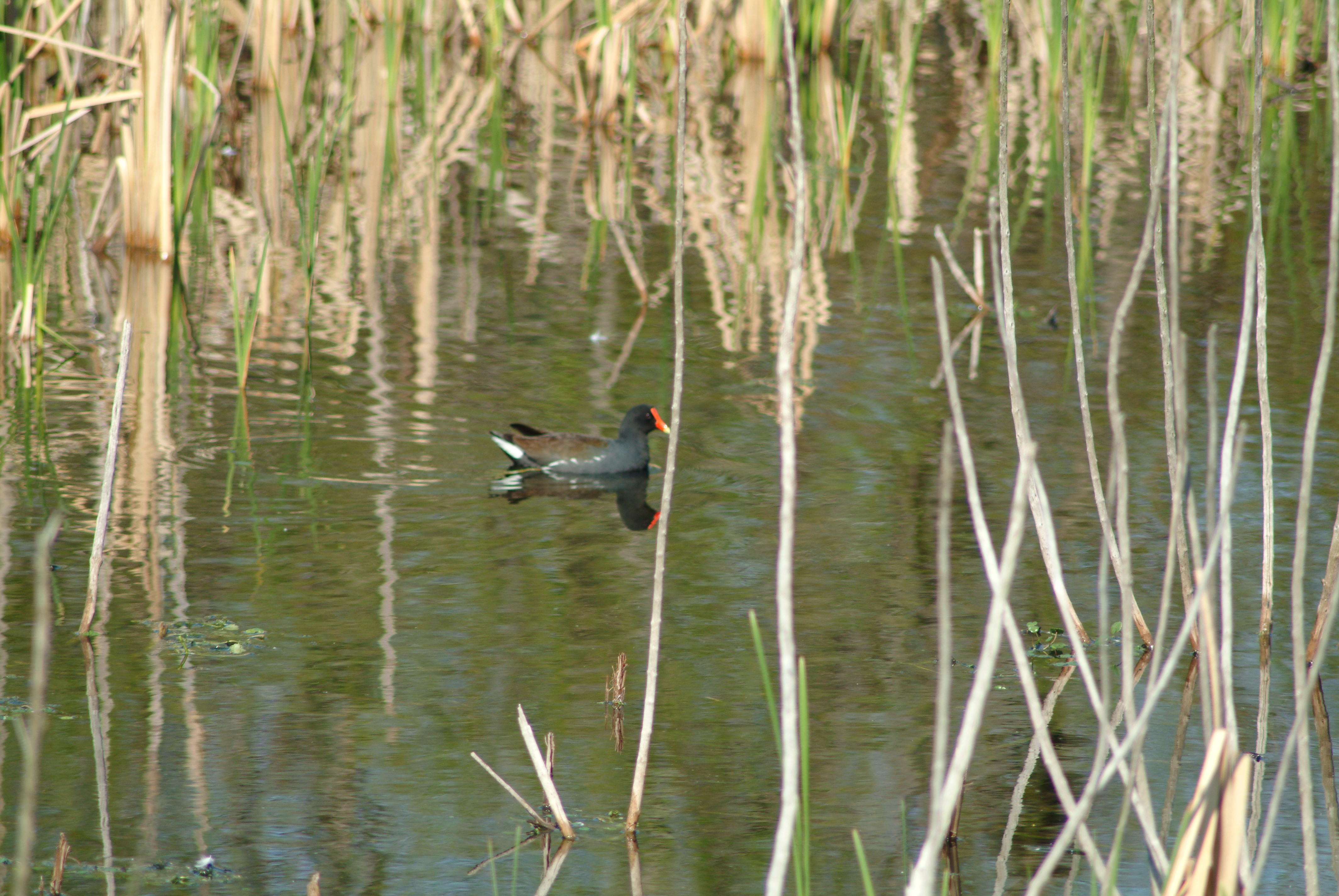
My father was not a serious birdwatcher, but he did love to take long walks, and on a few occasions he took along binoculars and joined me in birding – especially during the years when he and our mother lived in Bluffton, SC, near the South Carolina coast. During that time we visited Pinckney National Wildlife Refuge many times together, walking the trails and watching Common Moorhens and American Coots in the ponds, and also usually finding White Ibis, Great Blue Herons, lots of Eastern Bluebirds, Painted Bunting in the summer, Yellow-rumped Warblers in the winter, sometimes Wood Storks, and almost always at least a few other herons, egrets, ducks, shorebirds and songbirds. These pictures of us birding together at Pinckney, and some of the birds we saw – Common Moorhen and White Ibis – are among my favorite memories.

Dark-eyed Juncos, Song Sparrow, and a Sharp-shinned Hawk

December 2nd, 2013

The day began gloomy, with low gray clouds and a slow, cold rain that fell for a couple of hours. But as soon as the rain stopped, the clouds began to break apart and lift, turning pearl-gray and luminescent. Over the course of the morning, more and more blue sky appeared, leaving a loose, cottony quilt of small, high white clouds and sunshine.

Late this morning, like the past three or four days, birds were delightfully active in several spots. One of the highlights of the day was the arrival of Dark-eyed Juncos – our first of the season. Several fed around our yard, and flew in and out of shrubs and the low branches of trees, flashing the white edges of their tails. I paused to watch two that flew into a small tree, seeing once again the smooth charcoal-gray hood that covers the head, the small pink bill and white belly.

Then another sparrow-size bird flew up from beneath some wax myrtles and into the bare branches of a crape myrtle – a Song Sparrow, a heavily streaked brown and gray bird, switching its tail nervously from side to side, and raising the dark feathers on the top of its head into a slight crest. The brown streaks on its chest came together in a central dark spot. Though I’ve seen and heard Song Sparrows in other parts of the neighborhood this fall, this is the first one in our own yard – and I’m happy to see it and take it as another sign of more activity here, where things had been too quiet for too long.

On the edge of one hilly section of woods, a brown, long-tailed, medium-size bird glided from one tree to another nearby and sat there, quiet, still and unobtrusive, on a branch. With leaf-brown back and head and brown-streaked chest, it blended in so well with the trees I would never have seen it if I hadn’t seen it fly. A juvenile Sharp-shinned Hawk, its head was small and round, with pale markings on the face, and overall, it looked neat and almost delicate. Its lower half was mostly hidden by branches, so I could not see the tail well, except that it was long and narrow.

Although sometimes the presence of a small raptor like a Sharp-shinned Hawk can make smaller birds fall silent and still – in this case, the woods nearby continued to seem full of a good bit of activity and chatter, maybe a feeding flock moving through together – Carolina Chickadees, Tufted Titmice, Carolina Wren, Brown-headed Nuthatch, Yellow-rumped Warblers, Eastern Phoebe, Downy and Red-bellied Woodpeckers, a Ruby-crowned Kinglet or two.

After I watched the small, sleek brown hawk sitting in the tree for a few moments, not moving except to turn its head one way and another, I walked on. About the same time, it flew out of the trees and across the road ahead of me, and I could see its crisp, compact shape in the air, and its quick flap-flap-flap – glide flight pattern.