A Barred Owl Calls

March 1st, 2023

From the deep silence of a dark, still night came the sudden, booming call. Hoo-owwww, the call of a Barred Owl. It sounded very close. It was a mild night, not cold at all, with temperatures in the mid 50s, perfect for sleeping with open bedroom windows, but no crickets or other night insects singing yet. I’d been lying awake between 3:00 and 4:00 am, having trouble going back to sleep, when this big, rich, expressive call brought the too-quiet night to life. It’s amazing how much an owl can express with just one call. Not that I know what it was expressing, but it sounded full of life and detail. 

After that one call, silence returned for several minutes, maybe half an hour or more, and I thought the owl must have flown away. But then, just as unexpectedly, it called again, sounding as if it came from the very same spot. It sounded very close – though I know this can be deceptive. This time it called three, maybe four times, with just a few moments in between. Not the full who cooks for you but just one good strong Hoo-owww each time, ending with a slight, purring tremolo. I listened, but could not hear another owl’s call in response. 

Though a Barred Owl’s call is powerful and at times I would describe it as loud – as when two Barred Owls are caterwauling back and forth in their wild way. But when one calls like this, it seems to express a lower, more intimate quality – though certainly it still fills the night. I could almost feel this call as much as hear it, feeling it in my chest and stomach and heart, a velvety, feathery quality, warm and sensual. And that feeling of being connected to life outside in the night, on a restless, sleepless night, was a comforting thing.
Bathing White-throated Sparrows

February 23rd, 2023

Early afternoon on a softly sunny, unusually warm day for this time of year, I opened windows in a room that faces the front yard, taking advantage of the weather to let some fresh air into the house. There’s a birdbath that stands among the shrubs just below these windows, and I was a little surprised to see not just one or two but several small birds in and around it. We’d filled the birdbath with fresh water in the morning, the birds were obviously delighted, and the scene made me think of a renaissance painting of bathing nymphs in a sylvan setting.

Most of the birds were White-throated Sparrows, plump brown-streaked sparrows with black and white-striped crowns, neat white throats and pale gray breasts, birds that most often stay well hidden in shrubby vegetation and come out cautiously to forage for food on the ground. These were all enjoying a warm-day outing with what looked like unusual abandon. One sat in the middle of the pool of water, dunking, splashing and doing its best to keep others away. Other White-throated Sparrows were all around in shrubs and on the ground, either waiting or trying to get in themselves. One and sometimes two at a time sat on the rim and took sips of water, and now and then one would hop in and splash briefly before being chased out. Three White-throated Sparrows waited in the dense green yews right beside the birdbath and others foraged nearby in brown mulch and green moss. All of them were coming and going in leisurely ways, looking unusually peaceful and at ease, for the moment feeling safe and hidden in this little spot.

The dominant White-throated Sparrow sat and soaked, splashing its wings and fluffing out its chest feathers, looking so sensual I could almost feel the fresh, cool water. The gold accent on its face gleamed, and the white throat feathers shined. After several minutes another bold sparrow flew up and got into the water with the first one, and they both splashed around while others came one or two at a time for drinks. 

The interlude lasted for several minutes and finally ended when a bright red male Northern Cardinal flew to the rim of the birdbath, sending all of the White-throated Sparrows scattering like dry leaves into nearby shrubs and out of sight. 

Hermit Thrush – Grace Note on a Difficult Day

January 31st, 2023

This morning I tested positive for covid for the first time. I felt pretty rough with cough, congestion and other symptoms, so it wasn’t a surprise. The weather was darkly gray, cold, damp and felt miserable in every way. But in the middle of this dismal day there came one charmed and happy moment. 

Through an open window in the kitchen as I stood at the sink, I heard a soft, familiar chup among the other calls of birds nearby. And sure enough, after finding my binoculars and just a few moments of searching, I found a Hermit Thrush sitting on a low branch of an oak on the edge of the back yard. A gentle, pale-brown bird with dark spots on its throat and chest and a reddish tail that it lifted up and lowered slowly. It held its head erect, with the bill pointed slightly up, and it seemed to be looking back at me with a round, watchful eye, as I looked at it. 

It’s a bird I don’t see very often, though I know one has spent this winter so far in the shrubs around our house, coming out to forage in the mulch with sparrows and cardinals and towhees. A quiet, unobtrusive songbird, it has long been one of my favorites, so today it felt comforting to have this brief, sweet connection. 

A Gemmed Satyr Butterfly

October 15th, 2022

Late this afternoon, on a warm, sunny day when I’d been doing housework, I walked outside for a few minutes just to get some fresh air and see what I could find. Along the edge of our driveway, a small, pale-brown butterfly was fluttering low over a thick layer of dry brown leaves. Its color was so close to that of the fallen leaves it seemed to disappear each time it settled on one for a moment.

I had binoculars with me, but no phone, so I couldn’t try for a photo, but I did see a beautiful, close-up view several times as it paused on one leaf and then another and another. It never stayed still for long, and it held its wings up, not outspread when it was still. Its pale, gentle brown wings were patterned only with subtle reddish-brown wavy lines. I guessed it was some kind of Satyr butterfly, but there were no prominent eye spots. The markings that defined it were a line of small dark spots on the back edge of the underside of the lower wing, surrounded by iridescence that glittered like gold in the sunlight. 

I watched for several minutes as it fluttered over the dead leaves, settling here and there, until it finally flew further away and out of sight. I had never seen one before so I couldn’t identify it until I got back inside and looked it up. 

It was a Gemmed Satyr Butterfly, Cyllopsis gemma. An exquisite little creature, and so quietly colored and marked, so well camouflaged, that it could very easily escape any notice by humans at all. There was nothing bold about it to catch the eye. But once seen up close, it was delightful and very pretty, with the iridescence like tiny jewels decorating its lower back wing. Its name captures it perfectly.

Flames Dancing in the Air – Gulf Fritillaries

September 7th, 2022

On a warm late-summer morning, sunlight poured onto a small, weedy patch of foxtails – tall, tan grasses with soft-looking brushy tops that stood among other wild grasses and plants in a rough clearing in patch of woods. In the air above and all around the sunlit foxtails, danced dozens of bright, burning-orange butterflies all fluttering rapidly, in constant motion. A flowing, shimmering cloud of golden orange, with sparks of black and silver. 

The butterflies were Gulf Fritillaries, medium-size and brilliant orange with delicate patterns of black markings and three tiny white dots outlined in black on the upper side of their wings; and on the underside, elongated, iridescent spots of silver-white.

Gulf Fritillaries are a common species in this part of the South, often found along woods’ edges like this, or along roadsides, in parks or in yards with flowers. They used to be very common here at this time of late summer. But this year, I’ve seen very few of them – or of any butterflies at all – so this sudden gathering was so unusual it felt enchanted, and I stayed to watch them for several minutes. Every now and then, one would settle briefly on a foxtail or blade of grass, but it never stayed long before it flew again. Mostly they stayed in swirling, flickering motion over this magical little spot.

Yellow-throated Warbler

September 2nd, 2022

September has begun gently this year, with pleasantly warm days and softly sunny skies. Many birds have fallen quiet now, in these late days of summer. But early this morning, soon after sunrise, some of our most familiar neighborhood birds still greeted the day with songs and calls –Carolina Wren, Carolina Chickadee, Tufted Titmouse, Red-bellied Woodpecker, Downy Woodpecker, White-breasted Nuthatch, and a good many Blue Jays and American Crows. 

A Chipping Sparrow sang its long, level, summery trill from a small tree along the side of the road. A Pine Warbler’s cool, lyrical notes drifted out from a well-screened spot in the pines.

In a large pecan tree on the edge of a neighbor’s yard I noticed several small birds flitting around among the leaves and stopped to check them out. There were Chipping Sparrows, an Eastern Bluebird, a House Finch. And then my breath was taken away by the glimpse of something more exotic – though I only saw it in pieces at first. A flash of yellow, black streaks on snowy white, a rather long bill, a gray back, a white wing bar. The bird moved quickly and constantly through the leaves, creeping along branches but staying mostly hidden, so I could only see it in fragments, like teasing pieces of a moving puzzle. Finally, I caught a quick, vivid view of a burning yellow throat and a strikingly patterned face with a black mask and white curve over the eye, as the bird emerged from the leaves for a moment, head and long bill tilted up, and neck stretched up in the sun. It was a brilliant Yellow-throated Warbler. 

A Yellow-throated Warbler is considered a common woodland bird of the southeastern U.S., but I have very seldom seen one here in our own neighborhood, or heard its song here – a pretty series of bright, clear notes that quickly identify the singer. It’s a colorful wood warbler that spends most of its time high up in the canopy of forest trees. Its upper side is mostly gray, with white wing bars, white underneath, streaked with black, a black and white face, and a vibrant yellow throat. This one was quiet, almost serpentine in its movement, intent on searching for insects and other small prey as it crept along a branch, probing the bark and leaves with its long bill.

Brown-headed Nuthatches

August 24th, 2021

Two little Brown-headed Nuthatches chattered as they explored the top part of a dead pine snag this morning. The snag has lost most of its bark so its surface is bare and pocked with holes and cracks of different shapes and sizes. There’s one hole larger than most, very near the jagged, broken-off top, and I watched as one of the nuthatches hopped inside this hole, and then I heard tapping that went on for several moments. The other nuthatch stayed nearby, searching over the top part of the snag, and the two called in squeaky, cheerful-sounding notes, back and forth.

Brown-headed Nuthatches are very small birds with short tails and long bills, a blue-gray back, brown cap, and white throat and breast. Lively and active, they are found most of the time in pine trees. They stay in touch with notes that sound like squeaky toys as they move quickly up, down and sideways over trunks and branches and in clumps of pine needles, searching for insects and spiders. 

Brown-headed Nuthatches are closely associated with southeastern pine forests, usually found in areas where pines are the dominant trees. They need standing dead trees for nesting and roosting, and mostly search for food in living trees. We’re lucky to have them here in our neighborhood, in patchy woods that are a mix of hardwoods and pines. Over the past two decades, many of the pines have died or been removed, so there are fewer than there used to be. But the nuthatches still have stayed around, so far, so maybe there are enough pines and snags to provide what they need. They are year-round residents here, and some stay in the same territories for years. They often come to our feeders in the winter – and in some summers they have come regularly to our hummingbird feeder with a water moat in the middle, to drink from the moat. 

Red-eyed Vireo and Summer Tanager – Grace Notes on a Hot Summer Day

August 24th, 2021

Early morning on a very warm, humid, brightly sunny day, two, maybe three, maybe four Ruby-throated Hummingbirds zipped and hummed and dueled around the porch, flying between two feeders, whizzing past the screens, perching in nearby oak branches. One twittered for several minutes as it hovered, visiting pink impatiens blossoms on the deck. 

A Mississippi Kite called a sweet pee-tooo, pee-too, nearby but not in sight, maybe perched in a tree, or circling low.

And this morning’s special gift – a Red-eyed Vireo sang its bright refrain in trees all around the edge of the back yard, traveling from one side to another and on, passing through.

Later in the morning, as I walked up a wooded hill, a rather long, sturdy songbird, in shades of mellow-yellow and brown, flew out of the trees and paused on a low branch of a pine. A Summer Tanager, a female or an immature male, reminding me that fall migration has begun. Birds still seem quiet and scarce, and hot summer days will linger here for another month or more, but it’s late August, and changes have begun. Lots of brown, crumpled leaves of pecan trees litter the ground, and sprinkles of red-orange leaves dot some of the water oaks. Two Common Grackles flew over, calling harsh checks, and American Robins are gathering in small groups in shady yards.

Arrow-shaped Micrathena Spider

August 20th, 2021

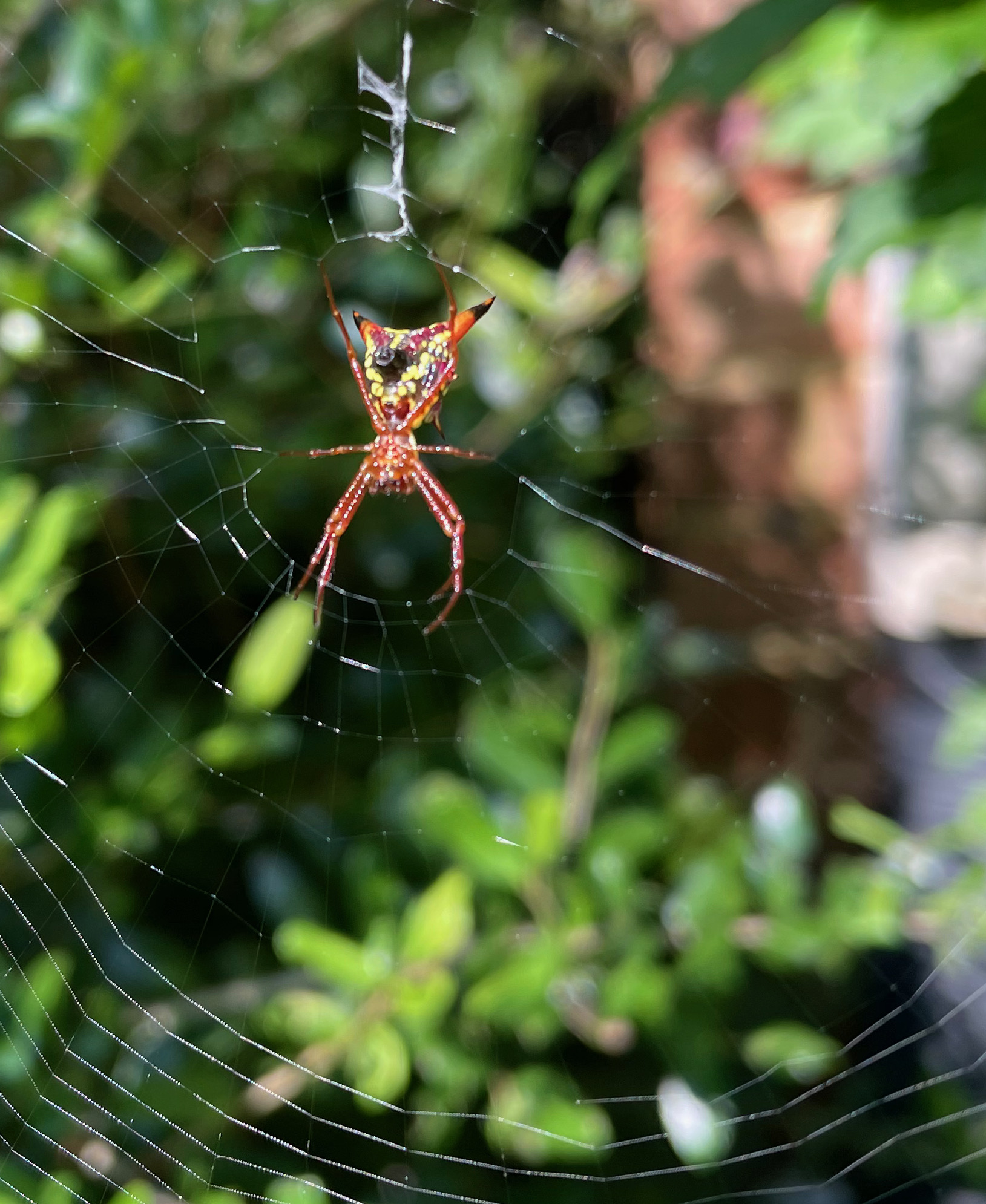
This morning I found this very tiny, colorful spider in an intricate orb web among the leaves of a holly bush at one corner of our house. With its vibrant colors it sparkled in the sun, showing up well, even though it’s only about .3 inch long. 

Arrow-shaped Micrathena spiders (Micrathena sagittata) are common in eastern North America and Central America, usually found in wooded places, often close to the ground. Instead of being round, the abdomen is triangular in shape, like the head of an arrow, and sharp spines stick out from its edges. Two large, fierce-looking, black and red points extend from the rear of the abdomen and point away from each other. The spines may serve to deter predators. Micrathena spiders are also called Spiny Orbweavers.

A Different Call from a Mississippi Kite

August 13th, 2021

Today while I was walking, I again heard the sweet, whistled pee-tooo calls of a Mississippi Kite, and turned around in time to see one flying toward the dense green canopy of several tall trees. As it neared the treetops, the kite gave a pretty, stuttering series of high call notes that sounded different – similar to the pee-tooo calls but with more and shorter notes. The kite disappeared into the trees, and a second Mississippi Kite whistled as it circled nearby. 

I’d never heard this call before, and when I looked it up after I got back home, I learned that this multi-syllable call is less often heard, and is commonly used by the kites when interacting with a mate or nestlings.