A Summer Tanager Day

May 1st, 2009

A Summer Tanager has been singing in the woods often since its arrival in mid April, and the pik-a-tuk calls of a pair frequently lace through the leaves of the trees around the house, but I hadn’t been able to see one until today. This morning after breakfast, the rumors continued. Through the kitchen window I saw movement in the big, floppy green leaves of the white oak branches that hang over the deck and went outside – and could hear the pik-a-tuk calls and see the rustling movement as birds moved through the foliage, but they remained mostly hidden still, moving further and further away.

It was late in the morning as I walked up the driveway toward the mailbox – when my mind was on something else entirely and I least expected it – when a male Summer Tanager appeared right in front of me, perched on a low branch of a pecan tree. It sat there, calm and quiet, stretched out in its typical, rather low posture, giving me a beautiful close-up view, deep blushing-red all over, with darker, shadowed red wings and long, heavy bill. The feathers on his crown were fluffed into a crest.

A little further up the driveway, in accidental contrast to the sturdy, handsome, deliberate Tanager, a female Ruby-throated Hummingbird hovered like a whisper, low over a carpet of tiny, low-growing wildflowers that spread in a yellow-spotted cloud over an open stretch of the yard. Many of the flowers have gone to fluffy seeds, like dandelions, and she was gathering the fluff.

It was a warm, sunny, perfect May Day with a soft blue sky thickly scattered with loose white clouds, and lots of birdsong and activity.
Black-throated Green Warbler

May 1st, 2009

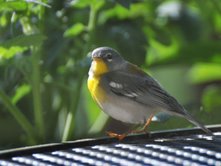
Early in the afternoon, I was sitting out front after lunch for a few minutes – much too nice a day to stay inside – listening to the calls of a Great-crested Flycatcher, Blue-gray Gnatcatcher, Phoebe, and a couple of Brown-headed Nuthatches, and the songs of a Yellow-throated Vireo, Red-eyed Vireo, Northern Parula and Chipping Sparrow, and watching our Bluebird pair continue to bring food to the nest box – when I heard a buzzy song in the treetops that caught my attention – trees-trees-whispering trees. I’m not good at recognizing most wood warbler songs, but this is one I’ve always especially loved – a Black-throated Green Warbler, a small, vividly-patterned woodland bird that looks like its name – with a greenish back, bright yellow face, olive crown, black throat and bold patterns of black and white in its wings and flanks. Its song is usually described as something like zee-zee-zee-zooo-zeet, but somewhere I heard the more poetic description, and that’s what I’ve always remembered. Trees-trees-whispering trees.

I could see it rustling through the highest part of the treetops, but the most I could make out was a glimpse of black as it moved, so I never really saw it, and then it disappeared and I couldn’t hear its song anymore, so it must have flown on.

Great-crested Flycatcher at End of Day – And the Call of a Barred Owl

May 1st, 2009

A little before 7:00 this evening, the weather was warm, murky, cloudy, and humid, and the woods were mostly rather quiet. But a Great-crested Flycatcher put on quite a show at the edge of the woods, flying from low limb to limb, calling whreep in a clear, sharp way, and sometimes whrrrreeep in a deeper, rolling, burry way, and sometimes a short, gurgled burrt. It perched on broken-off dead snags in full view, looking all around, showing off a long-necked regal profile with the fine crested head, long bill, pale yellow breast and long cinnamon tail. Directly from the front, it looked comical, its eyes tiny in a big head that looked like a beehive hairdo, turning sideways as if to peer down at me. It moved from branch to branch, hawking insects, and once coming out of a cluster of oak leaves with a wriggling caterpillar, which it snapped quickly down.

The day ended well after dark with the call of a Barred Owl, something we have rarely heard the past few months. It only called three or four times, a simple, long HOOO-oooawww, ending in a long, rumbling vibrato. I made the mistake of going to the window and pushing it open a little further, and heard no more after that.

Northern Parula

April 26th, 2009


A Northern Parula – a small warbler that’s often found in wooded areas near streams or wetlands – has been singing in the trees around our house since late March. Its buzzy, rising trill has become one of the most familiar songs of the morning – and much of the day.

This morning a Parula visited our deck, checking out all the ferns and other plants, and then pausing on a table for several minutes, just looking around – long enough for Clate to get some very nice photos.

Its blue-gray head, green back, and bright yellow throat and breast were vivid. It always feels like catching a glimpse of something magical to see a tiny, colorful woodland bird like this so close up, one that usually stays well screened in the trees.

Because the breast band was little more than a smudge – not the coral and black of a male – I think this one was a female, but it might also have been a first-year. I don’t know them well enough to tell for sure.

Either way, it was special to see, and a nice way to start the day.

Baltimore Oriole

April 25th, 2009

This morning between 7:00 and 7:30, a brilliant male Baltimore Oriole fed among clusters of catkins and new leaves in the tops of pecan trees in our yard. It sang a clear, mellow, whistled song and sometimes gave a rattling call as it moved. Its sunlit orange and black among the green leaves was stunning, and its song was lovely.

Acadian Flycatcher, House Wren, and Black and White Warbler

April 24th, 2009

Today three more bird species made their first-of-the-season appearance here. The familiar call of an Acadian Flycatcher from its usual territory down around the creek in the woods came about on schedule. I’d been listening for it the past few days, and thought I might have heard it yesterday and the day before – but this afternoon, its sharp WHEET-sit was clear and repeated.

Meanwhile, a Summer Tanager, Northern Parula, Red-eyed Vireo, Phoebe, and Carolina Wren sang in the woods nearby, with a Louisiana Waterthrush singing down near the creek now and then. A Great-crested Flycatcher called its deep, rolling Whreep, and four Chimney Swifts twittered overhead.

The female Ruby-throated Hummingbird sat on her nest, but left it for long periods of time. She did not seem to be working on it today, and each time I went outside, she flew away after only a few seconds.

First thing this morning, a House Wren was singing its bright, cheery song in the trees around our front yard, and it continued singing throughout the day – this was the second “first of the season” bird for the day, at least here around our house. I first heard a House Wren singing in another part of our neighborhood about a week ago, and on a late morning walk today – a very warm, bright, sunny day with temperatures that are expected to climb into the upper 80s – House Wrens were singing in four other places.

A Scarlet Tanager sings in the woods across the street, seeming to follow the same pattern of movement around a territory that one did last year. I’m thinking it’s the same one that has returned, but don’t know that for sure. A Red-eyed Vireo also sings in this area – and there are a good number of other Red-eyed Vireos in the woods around the neighborhood. One Yellow-throated Vireo sings from the treetops down near the corner. Blue-gray Gnatcatchers are active all around the yard, and their spee-spee calls are heard all day.

The high point of the morning came near the end of my walk, when I was passing a deeply wooded area near a creek, and heard the high weesa-weesa-weesa call of a Black and White Warbler. This is the first time I’ve heard or seen a Black and White Warbler here this spring, and that’s very unusual. They’re usually among our earliest returning migrants, so I was beginning to wonder what had happened to them, and was happy to hear it.

Pileated Woodpecker – Listening?

April 24th, 2009

This afternoon a male Pileated Woodpecker flew into the lower part of a tall pine on the edge of the woods. After waiting for a few quiet, still minutes, he hitched up the trunk, making scratching sounds as he went, then suddenly let out a loud, startling trumpeted call. He attacked a small, thin dead stub, splitting it open, seemed to find nothing of interest there and moved further on up the trunk.

He paused, clinging to the bark and staring at the trunk, turning his head only slightly one way, then another, then staring at the trunk again. He scratched the side of his head with a foot, then rubbed one cheek against the trunk. I thought it interesting how much time he – and other Pileated Woodpeckers I’ve watched – spent apparently doing nothing. Just being there. Though I suspect he is doing something, and I just don’t know what it is. I wondered if he could be listening for the sounds of insects under the bark?

In a quick search, I did not find many references to this possibility. The Birdwatcher’s Companion to North American Birdlife (by Christopher W. Leahy, page 384) notes, “there is some evidence . . . that woodpeckers can hear grubs and other wood-inhabiting insects moving in bark and trunks.”

And I found this more specific account on a Texas Parks and Wildlife website:

“The evidence of [a woodpecker’s excellent hearing] can be seen in the following account by a forester. ‘I once saw a pileated woodpecker fly to a tough old hickory tree in which ants were using a little knothole as their entrance. The bird didn’t drill in this obvious place. Instead, it circled the trunk, gently tapping, then pausing. Finally it proceeded to whack into the very heart of the ant nest – five feet below the knothole.’

“We do not know whether the bird heard the movements of the disturbed insects or was able to distinguish subtle differences in the tapping sound caused by the ants’ hollowed-out tunnels and nest. However, we do know that something pinpointed the spot where further investigation was needed and, since the bird cannot boast x-ray vision, it is fairly safe to assume that the woodpecker’s hearing played a major role in locating the ant nest.”

Ruby-throated Hummingbird Nest

April 23rd, 2009

A female Ruby-throated Hummingbird is building a nest on the branch of a large pine tree at the corner of our back yard. The nest is far out on the branch from the trunk, but under several other branches with some green needles that arch over it and may provide some shelter.

At first, the nest looks like just a grayish lichen-covered lump. I saw her fly into it by chance, when I had walked out onto the deck early this morning, and then watched as she made several trips to and from the nest, not staying gone for more than a few seconds at a time, and returning each time with something she applied to the rim and sides of the nest.

After a few minutes, I brought out my scope and was able to watch her for about an hour as she worked quickly and continuously and energetically.

What I can see of the nest looks like brown catkins covered with an outer layer of gray-green lichens and silk from spider webs.* I could not see inside the nest, except for little fluffy tufts of something sticking up that may be dandelion tufts or similar material. As I watched, she left for only a few seconds at a time and usually came back with spider-web silk in her bill – often with sticky strands streaming over her head and down her neck, too. Spider-web silk also extends up and down the branch from the nest.

Each time she returned, she sat in the nest and used her bill to apply the silk to the rim or outer sides, wiping her bill over the nest surface, and sometimes flicking out her tongue. Once she preened her rump feathers with her bill and then wiped it over the side of the nest. Sometimes she brought small tufts of other material and deposited it inside the nest with a vigorous stabbing motion.

Every time she came to the nest, after she had applied whatever materials she had brought, she wiggled around in the nest and seemed to be using her feet and belly to help press down the materials or shape the inside.

All of her feathers looked a little rumpled or ruffled up, on top of her head, and on her back, and this appeared to be because of her exertions. Her back and head were iridescent green. White showed around the outer corners of her eyes, giving her a wide-eyed look, and on her pale throat were subtle radiating rows of small soft spots. Every once in a while I heard her twitter, but she never came to the feeder while I was watching, and rarely seemed to be gone long enough to eat. During this time, she seemed entirely focused on nest building – though once she stayed gone for as long as a minute.

I have not yet seen a male Ruby-throated Hummingbird here, and saw no sign of one this morning as the female worked on her nest.

*The species account in Birds of North America Online says the nest usually is constructed of plant down such as thistle and dandelion, or bud scales, covered in lichen and all held together with spider webbing. So maybe what looks like catkins to me is scales or thistle. The account also says the nest is constructed by the female alone, and that she usually begins building it on arrival in the breeding area.

T.R. Robinson, R.R. Sargent and M.B. Sargent. 1996. Ruby-throated Hummingbird (Archilochus colubris), The Birds of North America Online (A. Poole, Ed.) Ithaca: Cornell Lab of Ornithology.

Hooded Warbler

April 17th, 2009

About 9:00 this morning – another cool, clear, sunny day – a Hooded Warbler sang in the low branches on the eastern edge of our yard, at the edge of the woods. I heard its bright weeta-weeta-wee-TEE-oh song, and found it not far away, a little olive-green bird with a bright yellow face and striking black hood, lifting his head and singing three or four times before flying into a large forsythia bush and out of view. Later in the day, I heard his song again two or three times from generally the same area. I’d like to think he might stay around, maybe near one of the creeks, but it’s more likely he’s just passing through.

Red-bellied Woodpeckers Mating

April 16th, 2009

Early on a cool, sunny, clear afternoon, a Parula Warbler sang and sang in the woods, a Blue-gray Gnatcatcher called spee, a Tiger Swallowtail floated through the trees, and a Phoebe, Ruby-crowned Kinglet, and Carolina Wren also sang nearby.

A male Red-bellied Woodpecker flew into the top part of a broken-off snag of a thick dead pine, about 25 feet tall. The snag has several broken limbs around the top and is partially screened by the leaves of a water oak beside it. A pair of Red-bellied Woodpeckers has been very active and vocal around this area for the past several days, and I wondered if there might be a nest hole on the other side of the snag where I can’t see it.

The Woodpecker went around the snag at the top several times, pecking now and then, but seeming restless. Then he hopped onto one of the branches and called a loud quuooorrr. His red cap glistened and shimmered like silk. A female Red-bellied Woodpecker flew to the branch beside him, and he immediately hopped on top of her and – I presume – they mated. It was only a matter of a very few seconds.

He immediately flew away to another tree nearby and made chucking calls. She stayed on the branch and preened under her wings, sort of flattened her body out, looked around, and was silent. After three or four minutes, she also flew away.