Snow Day

March 2nd, 2009


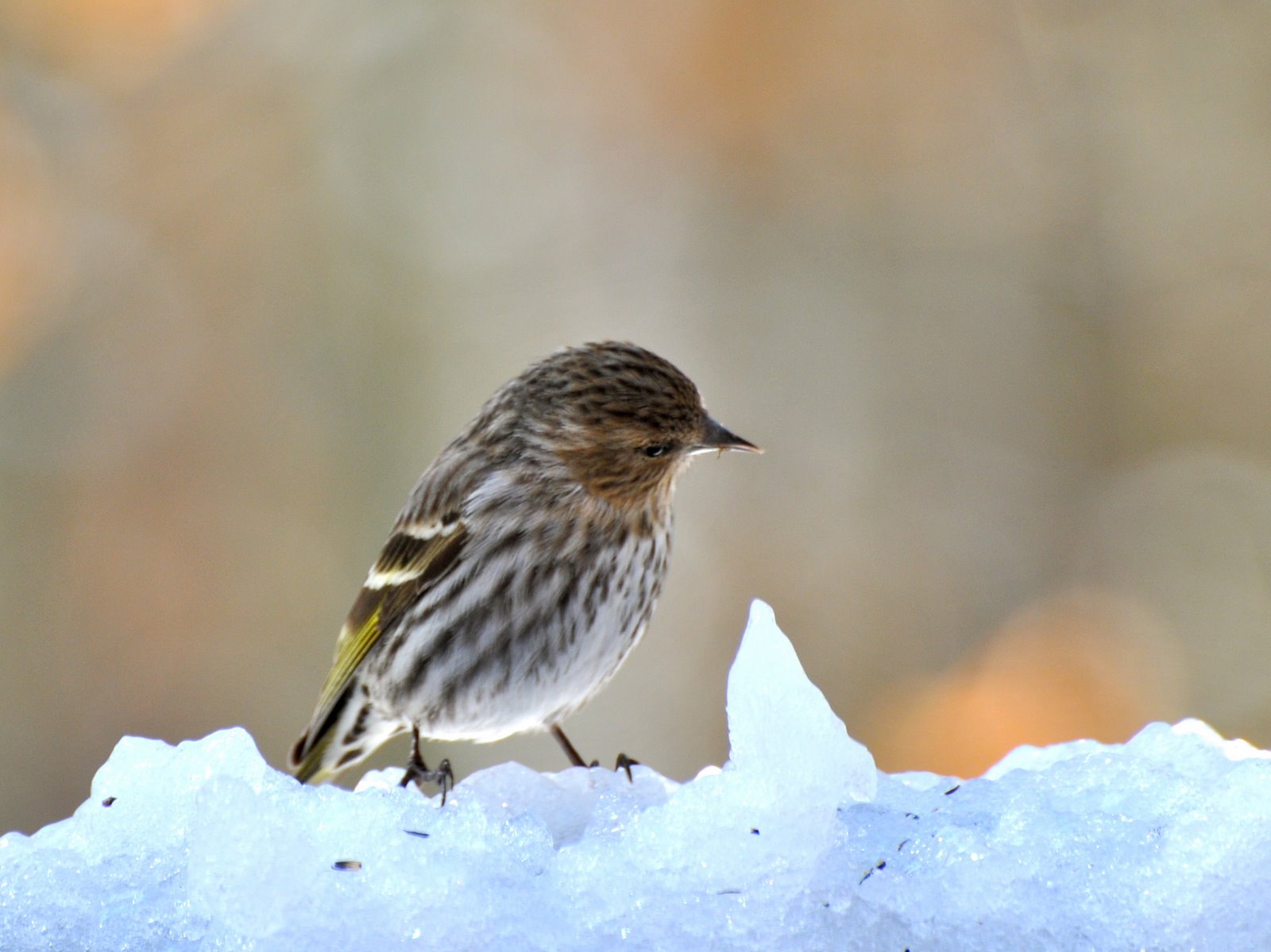
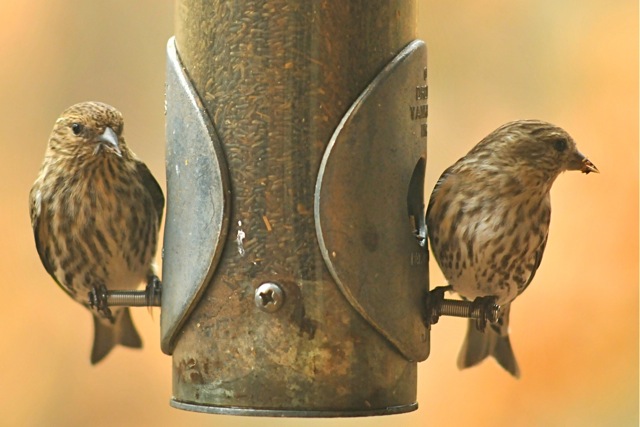
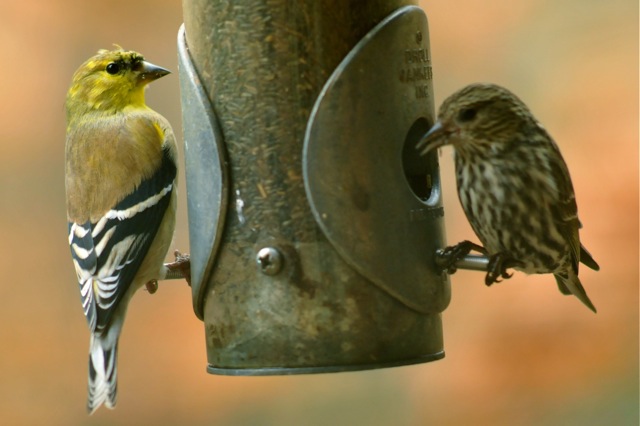
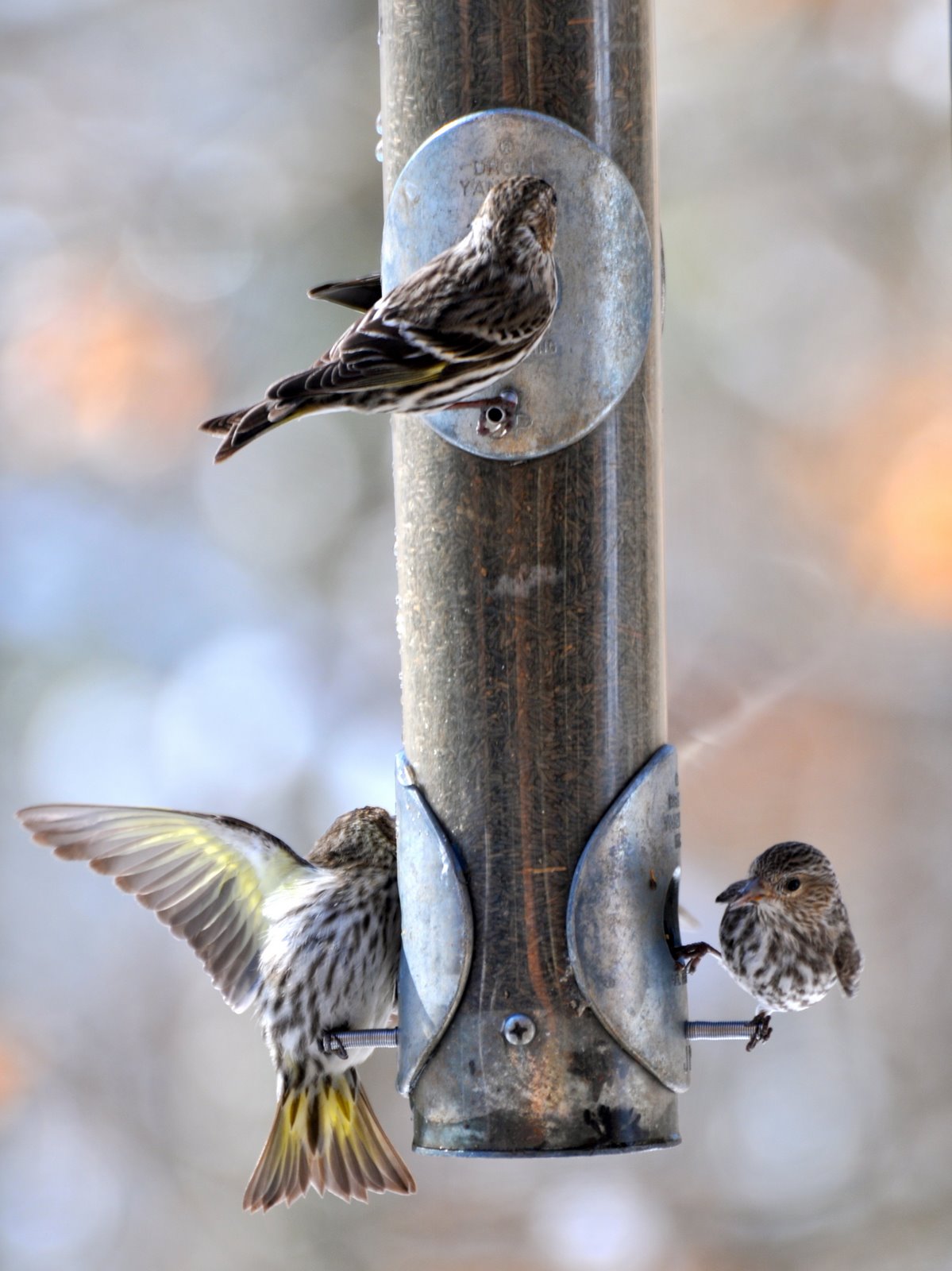
Yesterday afternoon and evening snow fell for several hours, filling the air with a slow, white drifting-down of snowflakes that piled up several inches on pines, on bare limbs, on every surface. Today – a rare winter wonderland here, with blue sky, bright sun and frosty snow – Pine Siskins kept the feeders busy all day. In the branches nearby, several were always sitting, one by one, waiting a turn.


Photos by Clate Sanders

Bird Showers

February 27th, 2009

In a calm, cool, steady rain this morning, a Red-bellied Woodpecker sat out in the open on a branch and took a nice long shower, fluffing up its feathers, fluttering its wings and preening. It stretched out low on a lichen-covered pecan branch and rubbed its belly vigorously, sat up, preened its breast and belly and under each wing again, and scratched its head with one foot.

In the branches of other trees nearby at the same time, two Blue Jays, a Titmouse, a Cardinal and a Mockingbird also sat out in the rain and fluttered, fluffed and preened.

A Yellow-bellied Sapsucker – a handsome black and white and buff, with a deep crimson throat – stopped by one of the pecan trees looking wet and disheveled. He shook his feathers and fluffed them out, but never paused in his work, tapping and circling around.

More than two dozen Robins foraged in the open grass, heads held high, running, stopping, looking around, now and then poking at the ground. Chipping Sparrows fed in the grass all around them, much harder to see, low to the ground, looking like moving pieces of the grass. Two black Starlings stood apart from the others, on the edge of the grass, as if not sure they wanted to be there.

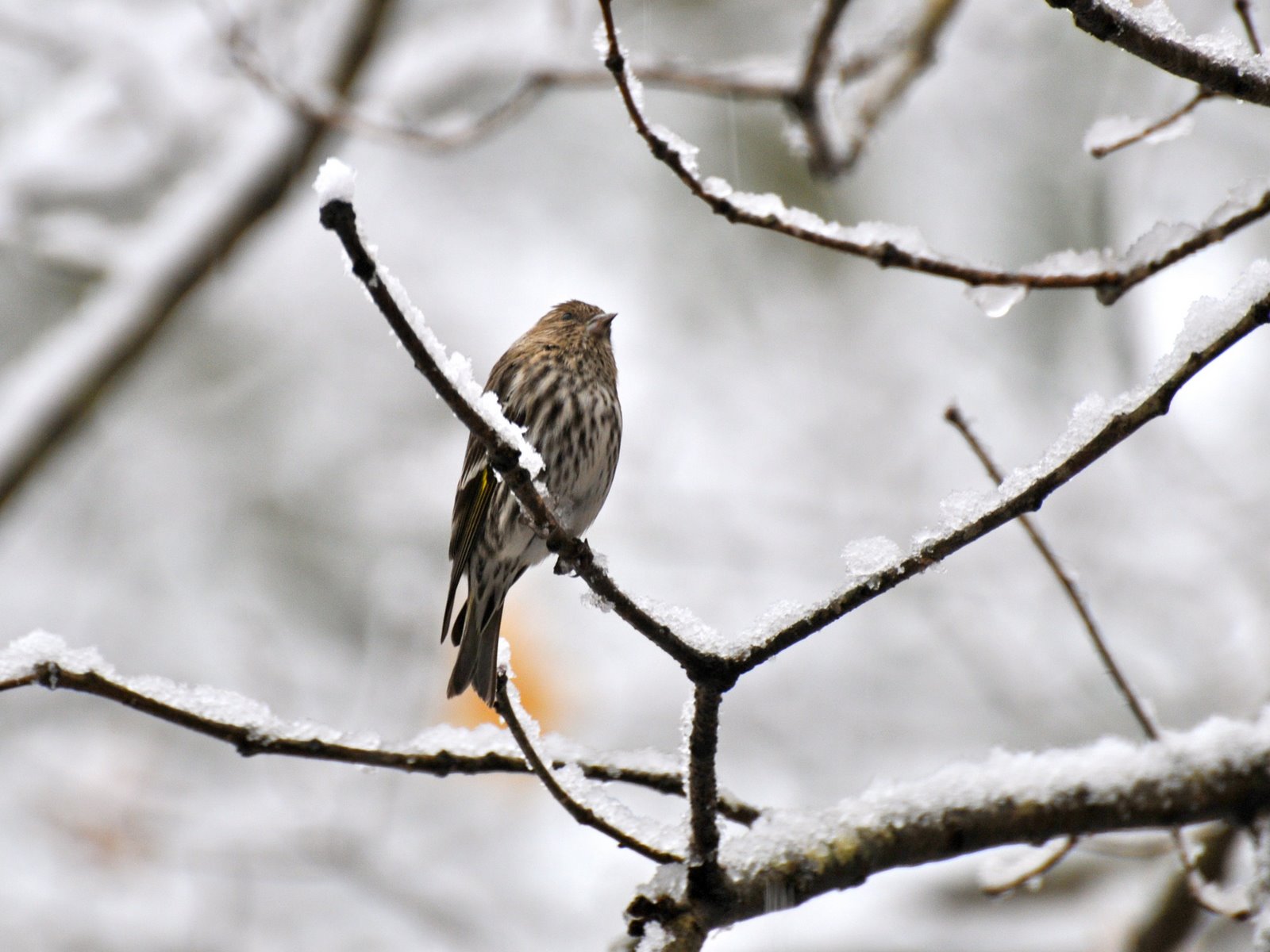
Two Pine Warblers and one Phoebe sang, a Mourning Dove cooed somewhere in the distance, and four or five Pine Siskins sat high up in the treetops and chirped and twanged zhreeeeee, a sound that still makes me smile every time I hear it. It’s a strange, exotic kind of music that for me is almost hypnotic – I just want to listen to it over and over again.

Lots of birds were active in the rain around the yard – Downy Woodpecker, Titmice, Chickadees, several Dark-eyed Juncos, Yellow-rumped Warblers, one Pine Warbler feeding in grass at the edge of the driveway, Bluebirds, and a male Towhee pecking at the ground in the shelter of wax myrtle shrubs.

The rain continued all day – a steady, soaking, welcome rain – until late afternoon, when it paused for a while and I took advantage of the break to get outside for a quick walk. Clouds filled the sky in many shades and shapes and fantasies of gray and white, some high and silky smooth, others low, dirty gray and thin, some whipped charcoal-blue, or milky-cream, or soft dove gray, or pearl, or sullen, drooping dark gray – and more. They kept my attention most of the way.

On the edge of the Old Field, a spray of about a dozen Song Sparrows flew up into tall, dead brown grassy weeds. Small flocks of Cedar Waxwings clustered in the tops of trees looking wet and less lively than usual. House Finches, Bluebirds, Cardinals and Brown Thrashers sang. And one Turkey Vulture perched on top of a utility pole with its wings stretched out to dry.
Birdsong in the Morning – Beginning to Sound Like Spring

February 26th, 2009

The day began with a cool, fresh-washed early spring morning, rainwater from light showers overnight dripping from the trees and a pale blue sky with clouds of peach and gold – and birdsong all around. Pine Warblers, Carolina Wrens, Cardinals, Chickadees, Titmice, Phoebe, Brown Thrasher and House Finches sang. A vivid black, rust-red and white Towhee sang from a sprawling yellow forsythia bush on one side of the yard, then from a small tree, then from the wax myrtles – making his rounds, I think.

A Red-bellied Woodpecker drummed on a limb and called its spring-time quuurrrr, Yellow-rumped Warblers called chek, Dark-eyed Juncos chittered, Mourning Doves cooed, Goldfinches mewed, Pine Siskins chirped and called zhreeeee. A pair of Bluebirds flew low across the yard, the male perched on top of the birdhouse and sang – then popped down and into the entrance.

The Evening Star and a Crescent Moon at Night

February 26th, 2009

In the last light of day, deep twilight, spring peepers sang from down around the creek in the woods. The western sky was a soft cloud-painting of mauve, orange, very pale turquoise, and smoky dark gray. Close to the horizon hung the thinnest sliver of a crescent moon on its back, with the outline of the full moon barely showing. And straight above the moon, directly, shined Venus, a big, bright, silvery star, looking much more brilliant than the thin, orange wisp of moon.

A Mixed Flock of Blackbirds

February 23rd, 2009

About 11:30 this morning I heard a sudden big whoosh of wings outside my office window, and when I looked, sure enough, the front yard was full of Blackbirds, several hundred perched in the bare limbs of the trees and spread over the grass and pine needles and leaf mulch, all making a racket in creaky, gurgling, chucking calls.

Although the largest number of Blackbirds in the neighborhood recently have been Red-wings, most of this flock were Common Grackles, gleaming iridescent black, with pale eyes, long tails and large, thick bills, looking sleek and handsome, especially the ones in the sunlight. It was a cold, clear, sunny day, and earlier in the morning the yard had been pretty busy with Titmice, Chickadees, Chipping Sparrows, Brown-headed Nuthatches, Pine Siskins, Downy Woodpeckers, Red-bellied Woodpeckers and Dark-eyed Juncos.

The Grackles took over completely, crowding impatiently onto the bird baths – as many as nine at a time trying to squeeze onto the rim of one – and covered the ground in a swarm, vigorously tossing up pine needles and leaves all over the place, and apparently finding something to eat there, maybe insects, maybe seeds. One Grackle held a large acorn in its bill. Several big Grackles also clung awkwardly to both feeders, pushing and shoving for a spot as they swung back and forth.

Red-winged Blackbirds were mixed in with the Grackles, plus a few Rusty Blackbirds and at least one Brown-headed Cowbird. In the bare limbs of one tree, two Common Grackles, one male Red-winged Blackbird and three male Rusty Blackbirds perched together, giving me a good opportunity to see and compare them – each quite different from the others, making me wonder why I sometimes have so much trouble distinguishing among them, even in a restless, quickly moving flock.

Several times they all flew up into the trees when something startled them, then pretty quickly filtered back onto the ground and feeders and bird baths. I watched from inside, through unscreened windows, because I knew if I opened a door and went out they’d all fly away. So I couldn’t see the whole flock well enough to get a good estimate of how large it was, but as they drifted on down the street after about 20 or 30 minutes, a cloud of several hundred rose up together at one point.

A Cooper’s Hawk, a Great Blue Heron, and a Rusty Blackbird Singing

February 23rd, 2009

Late this afternoon, with the sun low but still bright, Pine Siskins called their twanging zhrreEEE from the pines as I went out for a walk. It was pleasantly cool, with a light westerly breeze. Cedar Waxwings scattered high, thin, piping notes and perched in the tops of trees, facing the sun. Chipping Sparrows flew up from the grass along the roadside ahead of me. I had stopped to watch a House Finch singing from the top of a tree in one yard when a Cooper’s Hawk glided low across the grass and up into a tree on the other side of the yard. It sat facing away from me, calm and still for three or four minutes, turning its head one way and the other. It was a juvenile, with a brownish back, and when it flew, it showed a very pale, brown-streaked belly, breast and under side of the wings, and wide bands of dark and light in the flared tail. It stayed fairly low, flapping until it was out of sight.

Red-winged Blackbirds sang all along the way, scattered out here and there, but it wasn’t until I was heading back toward home that I came to a small part of the usual large flock spread out on grassy yards and in trees. Most of these were Red-winged Blackbirds and a few were Common Grackles. In the bare limbs of one pecan tree, six Rusty Blackbird males perched together. All were glossy black, with yellow eyes, thin, sharp bills, and a little rust still showing in the wings.

Two were perched close together, one slightly above the other, facing the sun and in particularly good view, and one of them was singing – a creaky, repeated song with two chucks, then a few gurgling notes – Chck-chck. Churk-urk-a-WEE! It had something of the quality of a Red-winged Blackbird’s song, but not nearly as full or colorful or appealing. Still, it was really fun to watch and listen as it sang.

When I was almost home, a Great Blue Heron flew over, flying north to south in a pale blue, quiet sky, flapping its huge gray wings slowly, steadily and gradually disappearing over the top of the treeline.

A Carolina Wren’s Morning Song

February 22nd, 2009

Each morning for the past several days, a Carolina Wren has begun the day by singing from a perch on the top of a plant hanger just outside our kitchen window. I hear its song first thing as I wake up, and later, it sings as we make breakfast and eat and read the paper and do the early morning chores.

A small, audacious cinnamon-brown wren with an upturned tail and a pale stripe over the eye, he sings a rich three-syllable song that sounds cheerful and bright and full of energy, and is answered in a loud purring buzz by a female Carolina Wren near by, and by another male in the distance repeating the same pattern of his song.

On the other side of the deck, Pine Siskins crowd the finch feeder in perpetual motion, and their chirps and zhreeeee calls make background music, along with the quurrrr of a Red-bellied Woodpecker and the loose, musical trill of a Pine Warbler in the woods.

In Donald Kroodsma’s book, The Singing Life of Birds,* he captures the stirring quality of a Carolina Wren’s early morning song perfectly, in a description of an hour before sunrise in Florida’s Corkscrew Swamp:

“I’m early, perhaps half an hour early, but I didn’t want to chance missing them. I need to just stand here, too, silently, listening, smelling, absorbing all that these wrens experience during these waking minutes. . . . . LIB-er-ty! LIB-er-ty! LIB-er-ty! LIB! There’s the first wren of the morning, a hundred yards to the east, a single song, a bold phrase repeated three and a half times on what must be the next territory over. The emphatic, powerful waves of his song radiate out, to be heard by all, everyone put on notice. Every leaf, twig, and trunk, every being within a quarter mile reverberates with each LIB-er-ty!, rousing every molecule and bone in my body, too.”

* Donald Kroodsma, The Singing Life of Birds, 2005, pages 346-347.

Pine Siskin Photos

February 15th, 2009

Several Pine Siskins continue to visit the feeder on the edge of our back deck. Mornings are the busiest hours of the day. At times there are Siskins at each opening on the feeder and several waiting on the deck rail or the top of the feeder or the branches overhead. From time to time, one of the waiting Siskins will decide it’s time for a change. It flies to the feeder and causes a great commotion of fluttering wings all around, and when they settle, the new one usually has a place.


My favorite part of watching the Siskins is listening to their calls. Around the feeder, there’s a constant chirp-chirp-chirping. When they’re up in the pines, several of them gathered to preen, or maybe foraging there, too, they use their buzzy-ringing zhreeeeeee calls, usually with a long, rising inflection – but I’ve also heard a slightly shorter zhreeee as a downward slurring call.

At times – usually during the late morning or afternoon – one Pine Siskin (not always the same one) will try to monopolize the feeder, fending off all others, lunging with spread wings and open bill at any others that approach.


Often during the day, one or two American Goldfinches manage to work their way in for a while. But most of the time, the Siskins seem to dominate, and we do not have large numbers of Goldfinches. Two Dark-eyed Juncos often feed on seeds scattered below the feeder.

Thanks, Clate, for these photos!

Red-shouldered Hawk Pair

February 13th, 2009

Late this morning – a beautiful cool, sunny, spring-like morning with a quilt of white clouds slowly drifting from west to east across a blue sky – two Red-shouldered Hawks flew into the top of a pine tree on the edge of our yard, calling a squeaking eee-er, eee-er a couple of times as they arrived. They perched close together there for a couple of minutes, a little unsteady among the pine needles, looking around, one slightly lower than the other. Then they flew together, staying close, dropping down on open wings and gliding up and over the tops of the trees in the woods across the street.

A Female Rusty Blackbird and a Sharp-shinned Hawk

February 12th, 2009

Late this afternoon, the sky was a clear, cool blue and the sun was sinking low as I went out for a walk. A Northern Flicker perched in the top of a tree in one yard, a House Finch and a Bluebird sang, and a few Cedar Waxwings flew over – but there don’t seem to be nearly as many Cedar Waxwings now as there were a week or two ago, when small flocks were scattered throughout the neighborhood.

Two Pileated Woodpeckers flew across the road ahead of me, one followed by the other, in the same wooded area around the middle of the neighborhood where I’ve often seen them recently. And I could hear the noisy chucking and creaking of the usual large flock of Red-winged Blackbirds and Common Grackles spread out further up the hill.

When I saw a slender bird facing the sun in the bare top branches of a pecan tree by the side of the road, I almost didn’t stop to check it out, but did, and through binoculars saw a taupe-colored bird with a thin, pointed bill – and a big bright yellow-gold eye. It was a female Rusty Blackbird in breeding plumage, with the sunlight giving her gray breast a warm brownish glow. I could hardly have been more surprised. I’ve been trying to find some Rusties among the mixed flock of Blackbirds that have stayed around for several weeks, but until now had not been able to find any since last fall.

As I watched, a small group of other Blackbirds flew over, making rather quiet chucking calls, and she flew with them.

About twenty minutes later, as I was on my way home and passing back through the same area, the large flock had moved in and settled restlessly in the trees and on the grass, and I found a few Rusty Blackbird males among them, all in glossy black breeding plumage, with no remnants of their rusty winter coloring.

A little further down the road, about the time the sun was going down, a bird of a different kind flew toward me, flapping and gliding, several feet above the treetops so that it still caught the light of the sun. It was a Sharp-shinned Hawk – the second one I’ve seen in a week, when I almost never see one at all. So I could hardly believe my luck. It flew directly over me, and I had a perfect view of its shape, with the long, distinctly square-tipped tail, small head and short, broad wings. It flapped quickly and glided, flapped quickly and glided, several times, and all in all, it was the clearest, best view I’ve ever enjoyed of a Sharp-shinned Hawk.