Oases in a Heat Wave

August 7th, 2007

This morning as I ate breakfast, I noticed three Titmice, a Chickadee and a Cardinal all competing for space on the hummingbird feeder hanging outside the window on the edge of the deck. I was puzzled at first, but then saw the Chickadee lean down from the chain and drink from the small moat of water in the middle of the feeder, meant to discourage ants. So they had come for water, not nectar.

Meanwhile, a male Ruby-throated Hummingbird hovered and hummed aggressively in the midst of the larger birds, darting at one and then another, his red throat flashing in the sunlight. The Chickadee jumped back from him a little, but stayed to drink another sip or two. I couldn’t tell if the Hummingbird chased them away in the end, or if they all just left when they wanted to, but once they were gone he hovered all around the feeder indignantly for several seconds.

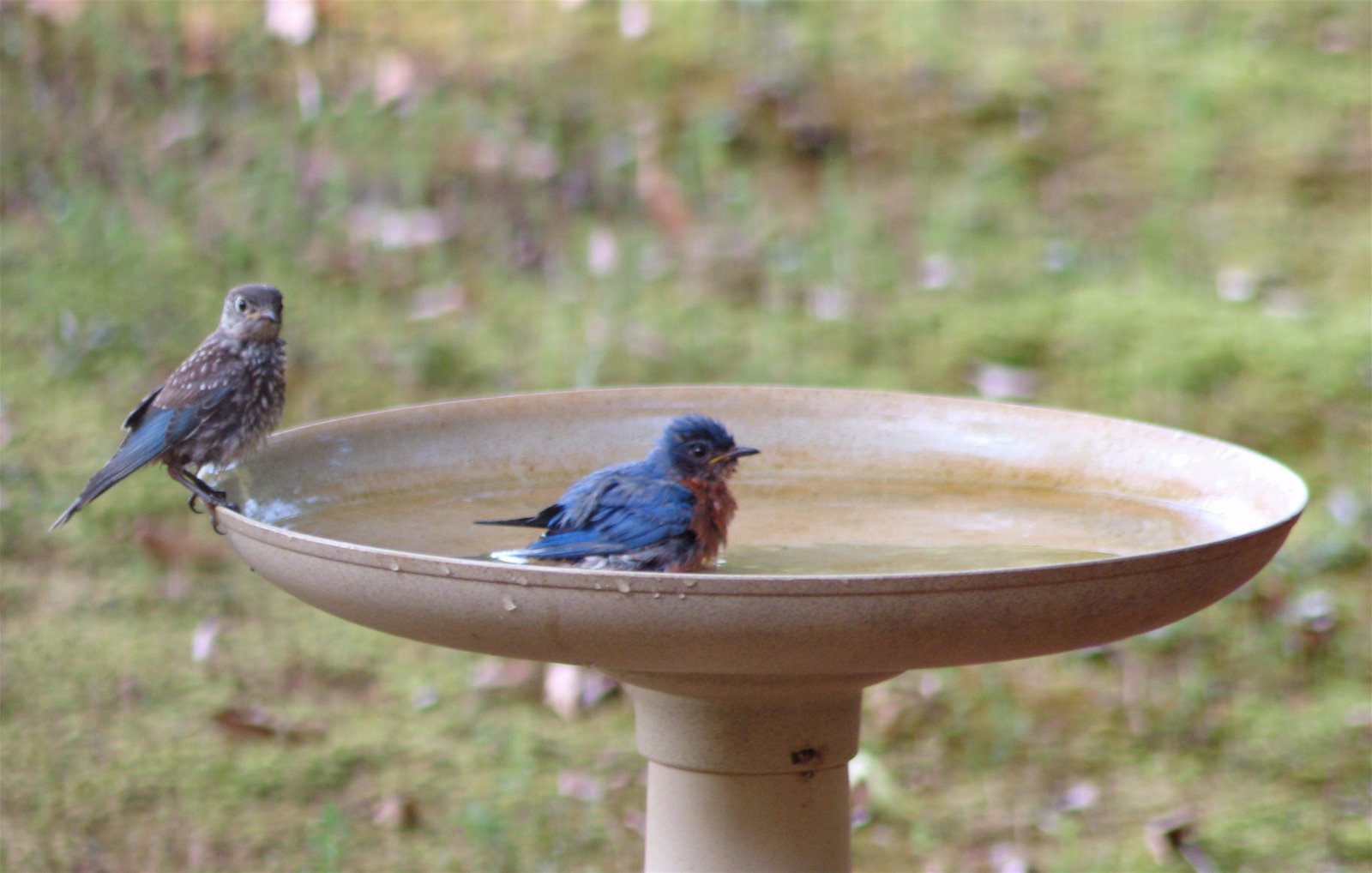
I’ve been especially careful to keep two bird baths filled with fresh water in the shade in the front yard the past few days, with temperatures in the upper 90s. This morning I filled two shallow saucers with water and also put some water in a large shallow plant saucer, added a couple of rocks for perches, and set them all on the deck rail in back, in the shade of the oaks, just below a large hanging fern.

Earlier, when I left the house around 7:30 to walk through the neighborhood – at least 45 minutes later than would have been ideal – the sun blazed and shimmered like pink-gold foil, climbing into a cloudless blue sky and bleaching it white as it rose. Cicadas already sang loudly, and I heard few birds along the way – the whreeps of two Great-crested Flycatchers, the soft burble of Bluebirds here and there, the twitter of Chimney Swifts, one Blue Grosbeak still singing, a few Towhees calling To-wheee, and a Catbird complaining in the thickets of the Old Field. Otherwise, things were pretty quiet.

The day’s expected to be very hot, with temperatures around 100, humid, and pollution in the air at unhealthy levels. The heat and humidity aren’t unusual for us at this time of year. The air pollution, sadly, isn’t unusual anymore either. While I can escape it by staying inside, at least after about 10 am, and being thankful for air conditioning, the birds, butterflies, lizards, trees, and other wildlife can’t, and I have no doubt the pollution can’t be good for them.

Royal Walnut Moth

August 6th, 2007


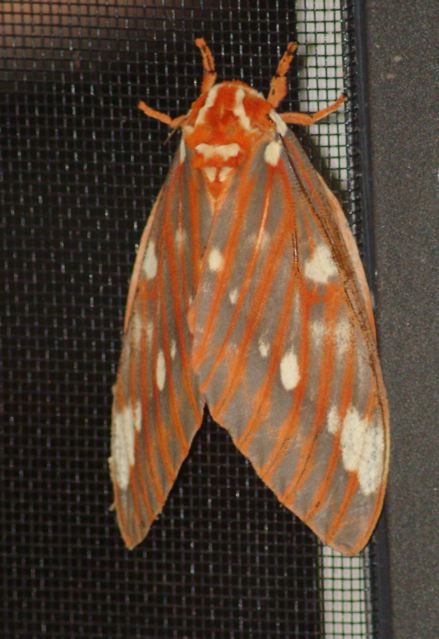
Early yesterday evening, Clate found and photographed a Regal Moth – also called a Royal Walnut Moth – on a window screen in the shade of our white oak trees. It was large and impressive, with rich orange coloring, especially on the head and the veins in the wings, and blurry spots of cream-yellow. From field guides, I learned that Citheronia regalis is fairly common, and – with a wingspan of five to six inches – is the largest kind of Royal Moth, and in the same family with Giant Silkworm Moths like Luna and Cecropia.

The caterpillars of Regal Moths feed on the leaves of several different species of forest trees, including hickory, black walnut, pecan, sweet gum and others. Called Hickory Horned Devils, the huge, brightly colored caterpillars look intimidating, with black spines on a blue-green body, and an array of black-tipped orange “horns” near the head, but they are said to be harmless. The adults do not eat, and live only long enough to mate and lay eggs.

Tiger Swallowtails, Silver-spotted Skippers and a Monarch

August 1st, 2007


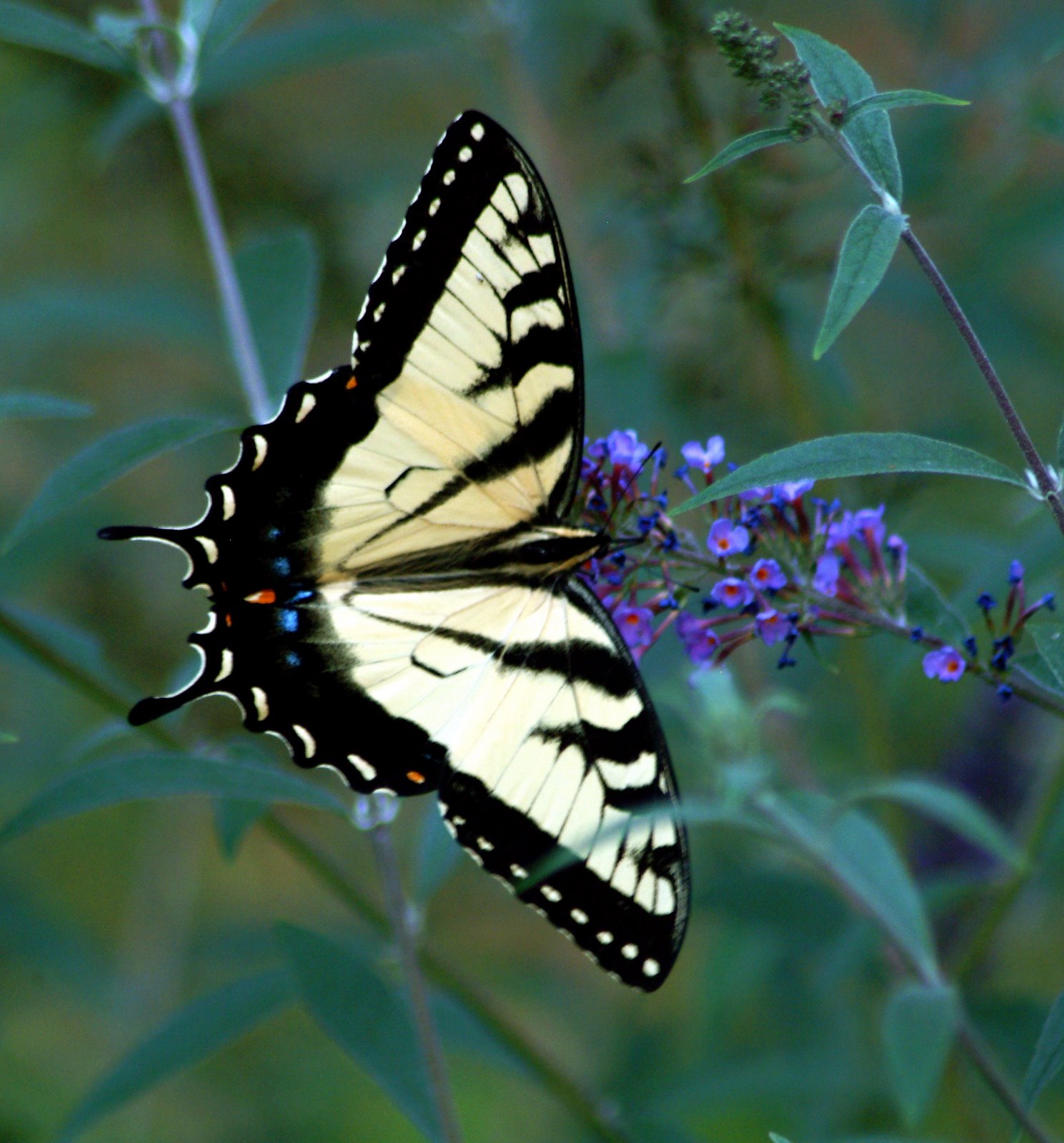
It’s getting to the time of year when I often watch butterflies and other insects almost as much as birds, since most birds are so quiet. Tiger Swallowtails, like this one Clate captured in a photograph, are the most noticeable butterflies around our yard right now. There’s almost always at least one or two floating through the trees or feeding on the blooms of a butterfly bush.

I enjoy the butterflies purely because they’re beautiful, of course – and often the greatest pleasure is in discovering the delicate colors and patterns of some that appear very plain at first glance. Learning to know them and recognize them is fun, and very similar to the joys of birding. And the colorful, sometimes fanciful and evocative names of butterflies alone might be enough to tempt me into watching them.

Red-spotted Purples are common around our yard – black butterflies with iridescent blue along the back edges of their wings and prominent red-orange spots on the undersides of their wings. Cloudless Sulphurs and Sleepy Orange butterflies flutter along the roadsides and over the Old Field on the edge of our neighborhood. And I might also expect to find Black Swallowtails, Buckeyes, Gulf Fritillaries, Viceroys, maybe an American Painted lady, and smaller, more subtly colored ones like Eastern Tailed Blues, Gray Hairstreaks and Common Wood Satyrs – all of which I’ve seen here in previous summers, but this year, especially lately, I’ve been preoccupied and haven’t been watching for them yet. I’m sure I’ve missed a lot.

Late this afternoon – a hot, humid, sunny day with a bleached blue sky and big white cumulous clouds – I went out to see what I could find. In the yellow-blooming lantana around the mailbox were several Silver-spotted Skippers, Fiery Skippers and at least two Common Sooty-wings. But the surprise of the day was to find a bright orange Monarch Butterfly feeding in the purple blooms of a butterfly bush along with a Tiger Swallowtail, several small bumblebees and a honeybee.

Summer Twilight

July 25th, 2007

Among the best things about summer in the South are the long, lingering twilights, when the sun sets late, fireflies flash in the grass and under the trees, and bats flutter and swoop in a dusky orange sky.

Clate and I have fallen into the habit of walking up our driveway each evening after sunset to a point where we can see the western horizon and the open sky, and watching as the last light and color of the day fade slowly away. Tonight when we first walked up, the sky was still pale blue, gentle, traced with graceful, high, thin salmon-colored clouds. The deafening songs of cicadas drowned out all other sounds. Fireflies winked over the grass of our yard, around the bushes and edges of the woods, in the weeds of the vacant lot across the street. Two bats hunted in the open space around our cul de sac, small, rapidly moving silhouettes darting sharply in one direction and another as they chased insects, dipping down suddenly over the grass and sometimes hurtling past our heads so close I could feel one pass.

The humid air felt heavy, still, and very warm, except for thin, damp, cool currents that rose from the darker edges of the woods and curled around my legs. A misty, blurry gibbous moon hung high in the south over the treetops behind our house.

We watched clouds, bats, and fireflies until the first stars came out – one bright evening star very low in the west, and one other, smaller pinprick of light almost directly overhead – then started back down the driveway as the last colors turned to gray, and the first raspy songs of katydids began to take the place of the cicadas. Just then, in deepest twilight, we heard a wind rise in the north, and turned to watch as it came toward us, moving across the treetops of the woods across the street, and traveling down through the trees and bushes of our yard, and finally reaching us – a cool, fresh air that rushed over and around us and tossed all the trees and bushes, a dark, clean, exhilarating wind that swept away the muggy air of the day – at least for a few passing moments. Then we went inside for the night.

Red Admiral

July 20th, 2007

Mid July has brought very warm, humid weather, as usual at this time of year. Today temperatures were in the 90s, under a pale blue sky with high, thin white clouds. Cicadas sang loudly all day, while birds have become much more quiet, still singing, but not as often, and not so many all at once, so that each song or call stands out more distinctly. Early this evening, an Acadian Flycatcher sang sharply and repeatedly near the edge of the woods, two Ruby-throated Hummingbirds zoomed and twittered and chased each other around the feeder, a bluebird sang in our neighbor’s yard, and three Carolina Wrens briefly sang back and forth. A Mourning Dove cooed in the distance.

The mood was sultry, hazy and somnolent, when a sudden splash of color – a strikingly patterned red and black butterfly – fluttered down and lit on a small table only a few feet away from where I was sitting. Its outspread velvet-black wings were distinctively marked with red-orange bars like “shoulder bars” across each forewing, and a broad red-orange bar along the edge of the back wings. Toward the front tip of each slightly pointed wing was a pattern of bright white spots, dots and crescents. At the ends of the slender antennae were small, dark bulbs. There were touches of indigo along the rims of the wings, thin white scalloping all around the edges, and subtle hints of bronze around the head – but the overall effect was the bold, vivid contrast of deep, soft black and warm ruby-orange, with flecks of shiny white.

It was a Red Admiral Butterfly, common here, according to my field guides, but I have rarely seen one so for me it was a memorable sighting. It stayed on the table, wings spread, for at least two or three minutes. Then it flew. A few minutes later it returned briefly to almost the same spot – but my slightest movement sent it off again.

Chipping Sparrows’ Nest

July 5th, 2007

Early this evening, we discovered a Chipping Sparrows’ nest on the branch of a pine in our back yard, only a few feet away from the back deck.

We were sitting on the deck, having a glass of wine and enjoying the evening. It was hot, but breezy enough to make it tolerable. The day before, I had noticed a small bird making frequent trips to the pine and suspected a nest, but the bird came and went so swiftly and quietly that I couldn’t even tell what it was. So this evening, I watched more carefully – and sure enough, it was clear before long that there was some kind of nest, though all we could see even through the scope was a brownish bunch of something.

Then a parent flew in, but was immediately so well hidden among the pine needles that I could not see it. All I could see was some movement around the nest – and an orangish glimpse of tiny gaping mouths. At this point, I still did not know the identity of the nesting birds, but finally one of the parents flew from the pine branch to a dead stub on another pine nearby – a Chipping Sparrow. We watched them off and on for the rest of the evening. They usually flew from the nest over the house toward the front yard, but occasionally dropped down to the grass in the back yard, near the nest tree, to hunt.

A Chipping Sparrow has been singing around the front yard for several days now, maybe even for weeks, out in the more open, grassy areas and around the shrubs. But I don’t usually hear them around the back yard – they seem to be quiet around the nest.

Summer Solstice

June 21st, 2007

The first day of Summer began quietly, well before dawn, with the solitary song of a Wood Thrush in the distance. Then a Summer Tanager began to sing right outside my bedroom window, joined by one, and then two Cardinals, then an Eastern Towhee, a Carolina Wren and a Bluebird. By 6:00 am the yard around the house was full of birdsong – Titmouse, Phoebe, Red-eyed Vireo, Great Crested Flycatcher, Yellow-billed Cuckoo, Black and White Warbler, Blue-gray Gnatcatcher, Brown-headed Nuthatch and Goldfinch, and probably others lost among the chorus. As I stepped out the front door to go for a walk at 6:30, the sky was a quiet gray with high rumpled clouds beginning to show faint pink.

The streets of the neighborhood were empty, the houses all quiet. I saw no one, and not a single car or truck passed me as I walked. Three Brown Thrashers sang along the way. A Blue Grosbeak sang from the top of a small pine. A juvenile Red-tailed Hawk sat in the top of a larger pine in the same area and screamed repeatedly, and a Yellow-breasted Chat whistled and cawed in the Old Field.

The rest of the day was a perfect summer day – hot, humid, breezy, with birds active, but in a much less hurried and exuberant way than in early spring. The morning sky was a gentle blue with high thin cirrus clouds, the trees a deeper, summery green. The whine and drone of insects, the heat and humidity, all combined to make it seem that everything has settled into a serious, but more relaxed pace. Tiger Swallowtail and Red-spotted Purple Butterflies floated among the trees and over the grass and flowers. The whine of Cicadas rose and fell.

Later in the morning, Chimney Swifts twittered as they swept overhead. A Great Crested Flycatcher called Whreep! from the low branches around the house. A pair of Ruby-throated Hummingbirds visited the feeder now and then, though not often. A female house finch came to the bird bath for a drink. A Red-bellied Woodpecker called its purring whirrrr. A Yellow-throated Vireo made its way through the woods, singing as it went. Paper wasps hunted around the shrubs, and green anoles skittered along the deck rails and up into the hanging ferns. And a Chipping Sparrow gave a long, level trill from a bush in the front yard, over and over again – becoming the most noticeable song of the morning.

A Yellow-billed Cuckoo sang its dry, exotic song all around the edge of the woods most of the afternoon, along with the pik-a-tuk of a Summer Tanager, the pit-seet! of an Acadian Flycatcher from down in the woods near the creek, and the complaining nyaay of a Red-eyed Vireo in the oaks – the sounds of a summer day.

Abandoned Nest

June 19th, 2007

It’s been a very pleasant, very warm late spring day with a stiff breeze and crowds of big gleaming white clouds passing steadily across a sky of deep, clear cobalt blue. Birds were active. In mid afternoon, I heard the call of a Yellow-billed Cuckoo nearby, and the songs of Black and White Warbler, Red-eyed Vireo, Summer Tanager, Scarlet Tanager, the whirr of a Red-bellied Woodpecker and the chatter of Titmice and Chickadees.

But – sadly – the Wood Thrushes seem to have abandoned their nest. Although the male sang around the back yard all morning as usual, the female is not on the nest and we did not see either of the pair approach the nest all day. We can’t see inside it, but have watched often in hopes of catching a glimpse of the parents.

Wood Thrush Photos

June 18th, 2007


My husband, Clate, has taken several pictures of the nesting Wood Thrush – including this one, in which the female (we think) has just arrived back at the nest after taking a break for a few minutes. The legs of the male can just barely be seen on the edge of the nest. He seems to stand guard beside it whenever she leaves for a brief time.

Both yesterday and today, we frequently saw the female standing on the edge of the nest and looking down into it, sometimes poking it. Then she settles back down. Early in the morning, she sits low in the nest, but later in the day she mostly sits higher or even stands over it, maybe because of the heat, and at times her beak is parted, as if she’s panting.

Once today, I saw the male arrive at the nest with something in its beak. Both he and the female perched on the edge of the nest and poked into it, then she lifted her head with what looked like a worm in her beak and ate it.

We don’t watch them all day, so I’m sure there’s a lot we miss – but keep the scope set up and have a look whenever we have a chance.

Thanks, Clate, for the pictures!

Timber Rattlesnake

June 17th, 2007

This morning we found a Timber Rattlesnake – dead on the road in our cul de sac. Its head was completely mashed and gone, and part of its tail was also gone. But the rest of its body was still undamaged, lying in an awkward S-shape on the road in the section that goes past a vacant lot grown up in tall grasses and trees. The snake was at least three feet long, and impressively thick around the middle part. A coppery stripe ran like a ribbon down the middle of its back, and a part of the sooty-black tip of its tail remained, but no rattle. The background color of its heavy-looking body was pinkish tan, crossed with jagged black bands.

I wouldn’t want to step on one of these in the woods, of course – where they usually stay. They feed mostly on small mammals like squirrels, chipmunks and rats. They are said to have a secretive nature and to be generally passive unless provoked – though if they are disturbed, they will strike and are venomous.

It’s a rare and interesting experience to see one, and it’s encouraging to know that enough natural habitat remains around here for them to continue to exist – though unfortunately, there’s one less around now.