Still on Her Nest

June 16th, 2007


When we returned home late yesterday, after a week-long trip, we were greeted by the song of a Wood Thrush in our back yard – and I was delighted to find the Wood Thrush female still sitting on her nest and looking bright-eyed and healthy. While we were gone, she survived a brief heat wave, with temperatures in the upper 90s for a few days; and then a heavy storm with wind and rain that blew down a few big branches here and there. But it was really the predators I was concerned about – we have a good many Blue Jays, Crows, Squirrels and other potential nest predators around. But so far, so good.

A Wood Thrush Nest

June 5th, 2007

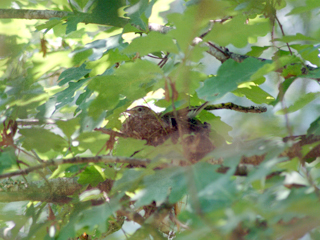
On a leaf-screened limb of a large white oak just outside our bedroom windows, a Wood Thrush is sitting in her nest. Nearby, at the edge of the woods and all around the back yard, the male Wood Thrush is singing.

I discovered the nest only a few minutes ago, around 1:30 this afternoon. Until yesterday, I hadn’t even heard one singing in our woods this spring – or for the past several years, except for the occasional one passing through – so I couldn’t have been more surprised.

Early yesterday afternoon, after several very busy days that kept me from spending as much time outside as usual, I had a few minutes to sit on our back deck after lunch and read. The weather was warm and humid, the sky pale blue with big restless gray and white clouds. Thanks to a good soaking rain over the weekend – after a long stretch of very dry weather – the grass and all the plants and trees looked fresh again, as if they had been washed in green. A gusty wind rushed through the woods, tossing the branches and leaves of the oaks, sweet gums and pines, and making the air feel clean and sweet. Now and then the wind paused, and the trees stood still.

From deep in the leaves near the edge of the woods came the flute-like, musical song of a Wood Thrush. It came like a gift, like the rain, refreshing and calming in a time that has been rather tense and demanding. For several minutes, I just sat and listened, surrounded by green leaves and serenaded by the music.

The song of a Wood Thrush used to be common in our woods all spring and summer, but for the past few years, we have rarely heard one here though one or two have continued to sing in other parts of our neighborhood. So I felt lucky to have one with us, even if only for a day or two.

This morning the Wood Thrush continued to sing all morning, right outside my window. After lunch, I went outside again – and just happened to catch sight of the female as she flew into the white oak only a few feet above me, and slipped down into her nest. The nest is about halfway out on a relatively low limb. It’s screened by leaves, but not hard to see if you know it’s there. Through the scope, we can see her wide, alert eyes and creamy white throat with dark streaks, and when she rose up for a few seconds to scratch, the bold black spots on her breast.

I’m amazed to have them nesting so near our house and almost don’t want to go out on the deck at all, for fear of disturbing her. We can watch her through the scope from inside. Right now, just after 2:00 pm, the male continues to sing all around the back yard as thunder rumbles around.

Scarlet Tanagers May Be Nesting?

May 29th, 2007

Yesterday evening, just after sundown, I listened for several minutes to the “chik-brrrr!” calls of a Scarlet Tanager in the woods behind our house. The sound felt electric, and I could almost feel a shivering buzz going up my neck as the calls moved through the deep green of the woods along the creek, from west to east. We’ve been hearing the Scarlet Tanager’s song almost every day since early May, and I think there almost certainly is a pair nesting here, though they are deep in the woods and not often seen in the open. They are said to have a preference for oaks, and I wonder if they might be nesting in the tall old white oak that dominates the section of the woods behind our house, on the northern side of Call’s Creek. One evening last week, the male flew over me, from the edge of the woods. I caught just a glimpse of crimson, with the band of black on the tail. They are so elusive, and stay so hidden among the green leaves of the hardwoods, that their presence might pass unnoticed, except for their distinctive song and calls, and the occasional glimpse of their burning red plumage.

Summer Tanager Pair

May 22nd, 2007

A pair of Summer Tanagers spends a lot of time in the trees around our house, and this morning I watched them together, preening among the leaves of a large white oak. The female – who spent much more time on her grooming than the male did, at least on this occasion – looked beautiful in a quiet, understated way, with her rich dark yellow breast, and olive-yellow back and wings. She was so close I could even see the faint yellow ring around each eye. She blended in so well with the leaves that I probably would not have seen her if they hadn’t flown in together – the rose-red male quickly catching my eye. With their long, thick bills and slightly crested heads, Summer Tanagers usually look more sturdy and strong than graceful, but this morning the female was the picture of feminine charm.

The male Summer Tanager sings early every morning right outside our bedroom windows, and often during the rest of the day, and their soft, staccato “pi-tuk” calls – often sounding very domestic and expressive – lace through the trees all day. It’s a pleasant, peaceful, summery sound.

Braveheart and Her Fawn

May 21st, 2007


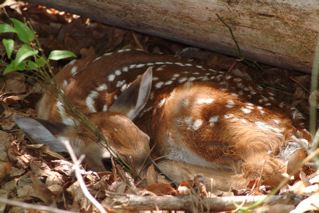
Braveheart, the White-tailed Deer with the crippled front leg, has a fawn. It is very small, with wobbly legs, and does not stand up long. When it beds down in the dry brown leaves against the trunk of a big fallen pine, it’s almost invisible.

When I stepped outside this morning, I saw the doe in our front yard, and she immediately began limping back toward me and the house, which was unusual. I sat down for a few minutes, and turned my attention to something else, then I saw her standing with the fawn, only a few yards away from our house, in the shade at the edge of the woods. The fawn took a few steps, but looked unsteady, then curled up beside the big trunk of the pine, deep in thick brown leaves, dappled by filtered sunlight. Its white spots and soft brown color blend in so well that it’s almost impossible to see, unless you see an ear move. Braveheart went back to browsing, making her way up the hill and pausing to munch on several lush green mouthfuls of my butterfly bush. Oh well.

We have far too many deer in the neighborhood, and I often feel annoyed because they eat so many of our flowers and shrubs. But it isn’t their fault their woodland habitat is being steadily destroyed by houses and subdivisions. Braveheart seems to have adopted our yard as her home territory, and I can’t help but feel sympathy and admiration for her, and hope she and her fawn will survive and live well.

A Botanical Garden Walk

May 20th, 2007

As I walked along the trail beside the beaver pond, I heard an emphatic “tsuk!” repeated in the shrubs beside me. A small olive-green bird flitted from branch to branch – and then I saw its face, a brilliant yellow-gold, with black markings around the eyes and trailing down its cheeks. A Kentucky Warbler.

I had heard at least four Kentucky Warblers singing at different places along the river, but didn’t expect to see one, because they usually stay so deep in the under-story vegetation. So this was a happy surprise, and the highlight of a beautiful morning walk in the State Botanical Garden in Athens. The weather was sunny, unusually cool, and birds were active.

Another highlight was earlier in the morning, in a section of power cut near the Oconee River. Here, the tall vegetation seemed to be popping with the colors and sounds of brilliant Blue Grosbeaks, Indigo Buntings and Common Yellowthroats. Both male and female Grosbeaks flew from stalk to stalk, and sometimes up in the branches of trees at the edge of the woods, frequently calling their metallic “plink!” An Indigo Bunting sat in the branch of a small tree and sang. Common Yellowthroats called “chttz!” and sang “wichery-wichery-wichery” from deep in the vegetation, and one flew up and paused on top of a stalk with a wriggling insect in its bill. In the bright morning light, its yellow face and throat, black mask, and even the blurry band of white above the mask glowed.

Meanwhile in the background, a Kentucky Warbler, White-eyed Vireos, Blue-gray Gnatcatchers, a Parula Warbler and an Acadian Flycatcher were singing. A Red-shouldered Hawk flew from a perch in a tall tree over the river and began to circle and cry, “keee-yer!” and was joined by two more Red-shouldered Hawks, all three calling back and forth as they circled and climbed higher.

From the White Trail that follows the river, I watched two Louisiana Waterthrushes hunt among the exposed roots and murky holes in the opposite bank. They moved quickly, with bobbing tails and frequently called out “chip!” A Prothonotary Warbler and a Hooded Warbler sang, along with more Parulas, White-eyed Vireos, Red-bellied Woodpeckers and Acadian Flycatchers. A Great Blue Heron and two Wood Ducks flew over.

In the beaver pond area, where I saw the Kentucky Warbler, two Red-headed Woodpeckers flew from place to place around the pale trunks of standing dead trees, their wings flashing white and their crimson heads gleaming in the noon-day sun. Two Phoebes sang and hunted from low perches, and another Common Yellowthroat sang – along with the thrumming songs of Green Frogs, and a clacking song that I think may have been Northern Cricket Frogs.

It’s a perfect time of year to be outside, when birds and other wildlife are so active, and was a perfect way to spend a fine Sunday morning.

Missing

May 19th, 2007

Most of the migrating birds have arrived or passed through our area by now, and there’s a feeling of settling into late Spring’s routines – lots of birdsong in the mornings and activity all day long. The weather is pleasant and sunny, but very dry, so the bird baths are frequently visited. Bluebird and Chickadee babies have fledged, and pursue their parents through the branches of back yard trees, begging insistently to be fed. Several evenings in the past week, in early twilight, we’ve heard a pair of Barred Owls calling from nearby in the woods.

Summer Tanager, Red-eyed Vireo, Great-crested Flycatcher, Acadian Flycatcher and Blue-gray Gnatcatcher all seem to be nesting somewhere nearby – and I’m still hearing the songs and calls of Scarlet Tanagers in the woods, and hope they may be staying here to nest too. A Wood Thrush sings along one creek near the entrance to the subdivision, and occasionally I can even hear one singing in he woods behind our house. I don’t hear the song of a Louisiana Waterthrush as often as in years past, so I think there may be fewer pairs, but at least we do still hear them occasionally.

Even though we’re lucky to have all of these, there are a few voices absent from our neighborhood this season – or very infrequent at best – and I’m beginning to think they won’t be back this year. We heard the call of a Yellow-billed Cuckoo yesterday evening for the first time, but only that once so far, and although I heard a Wood Peewee sing the morning of May 11, I haven’t heard one since then. I first heard the song of a Chuck Wills Widow the night of May 28, and continue to hear it most nights – but it’s far in the distance and barely audible. In years past, it sang loudly all night long from somewhere very near. So I miss it.

The Yellow-breasted Chats whose hoarse, strange calls have added character to the Old Field for the past several years haven’t shown up yet. There’s only one Indigo Bunting singing in the Old Field, and the two male Blue Grosbeaks that were sparring over territory in early May seem to have disappeared – though maybe they’re just laying low right now.

It’s possible some of the “missing” are here and I just haven’t heard them or am out at the wrong times, and it’s possible they may show up yet – but I’m beginning to think not, and if so, I’ll especially miss the sweet, plaintive song of the Wood Peewee that has graced our shady streets every summer until now, and the dry, exotic “cawp-cawp-cawp” of the Cuckoo. There’s been a lot of development nearby, and clearing along the creeks, leaving less and less habitat available for woodland-loving species.

A Tribute to David

May 17th, 2007

On May 1, a good friend and well-known Athens birder, David Galewski, died suddenly. He will be greatly missed by the Athens birding community, as well as by colleagues and friends in Athens, and at the University of Georgia, where he was a professor of mathematics. Over the past six years, I went birding often with David, including several memorable field trips to different areas along the coast of Georgia and South Carolina, the North Georgia mountains, the Gulf Coast of Florida and other destinations. Our annual field trips to the coast over Martin Luther King weekends each January, with birding friends from the Oconee Rivers Audubon Society, had become a tradition.

For several years he served as field trip chair for the Oconee Rivers Audubon Society, and in this position he was uncommonly generous in sharing his knowledge and giving huge amounts of his time and energy to help others.

I first met David in 2001, when I interviewed him for a magazine article about birdwatching. In that interview, I asked him why he liked birds so much and why he liked birding, and this is what he said:

“One reason I love birding so much is that birds represent a microcosm of life. Not only are birds beautiful and free and wonderful to watch, but through birds people can become attached to their destinies, and the next step is that they begin to become aware of the environment and of what’s happening to it.”

He was especially known for his knowledge of bird songs and calls, but the most important thing David brought to birding was not his amazing ability to recognize birds by ear. The real gift that he gave to those of us who birded with him was his love of the natural world, and a deep and genuine sense of wonder. He was never too cool to show his enthusiasm, not only for unusual or rare birds, but even for the most common and familiar.

His favorite birds – the ones he would really get excited about and looked forward to seeing again and again – were shorebirds – like sandpipers, plovers, seagulls, and terns. He knew them down to the smallest detail of plumage and the most obscure call, and he took delight in the unique personality of each one. He never just checked them off on a life list. Each one acquired a colorful and memorable identity, and became much more than a name or a picture. I’ll never hear the “tew-tew-tew!” of a Greater Yellowlegs, see the silvery flash of a Forster’s Tern’s wings, or hear the “pee-oo-eee” of a Black-bellied Plover, without thinking of David – and of the huge, immediate smile that filled his face whenever he encountered them again.

I can think of few gifts greater than the ones he gave to me and to many other birding friends – gifts of beauty, of music, and of living intensely in the moment.

But what I’ll remember most about David are the many times – and there were many – when we were birding together, and he would just stop and look around, and say, “Isn’t this just wonderful? We are so lucky! There’s nowhere I’d rather be than out here, enjoying the beauties of nature, and enjoying the birds.” So that’s what I’ll remember – the happiness and joy he found in the natural world, especially in birds, and the pleasure he took in sharing that joy with others.

A Familiar, Burry Call

May 6th, 2007

On a cool, wet, deeply cloudy morning, our woods finally turned green, just now recovering from the freeze of four weeks ago and opening new leaves. The windows of our bedroom were open, and I was making the bed and half-listening to bird songs and the rustle of wind in the leaves, when I heard a familiar “chik-burrr!” A sound I’d been hoping to hear for several days. I grabbed my binoculars and hurried outside – and sure enough, there he was, up in the foliage of the treetops near the edge of the woods – a brilliant splash of intense red with jet-black wings. A Scarlet Tanager.

Scarlet Tanagers have been back in the area for at least a week or two now. I’ve heard them singing and calling along the Oconee River and even in another part of our neighborhood. But I was beginning to think that maybe we wouldn’t have them in the woods around our house this year – so I was especially happy to hear its call, and I’m hoping it might stay around. Despite their flamboyant coloring, Scarlet Tanagers are rather reclusive, often hard to find, most often hanging out among dense clusters of leaves, even when singing. They’re a deep woodland species particularly sensitive to forest fragmentation, so their presence is a welcome reassurance that our woods are still healthy enough to attract them.

Splendor in the Weeds – A Blue Grosbeak

April 28th, 2007

At 6:30 this evening, the sun was still well above the horizon and the day warm when I went for a late walk. It was windy, and the traffic noise from Highway 441 was especially loud. I had not taken binoculars with me, and was concentrating more on thinking than on watching or listening for birds. But a dark gray bird caught my eye when he flew from one bush to another in the weedy Old Field that lies between the road where I walk and the highway.

He sat low on a branch of privet, switching his tail, mostly in shadow, so that what I could see of him was little more than a silhouette. But his beak glinted silver, and his head looked large and slightly peaked. With all these hints, I still didn’t recognize him for a moment, and it wasn’t until he flew, crossing the sunny road to a small tree on the other side, and showing his large silver bill even more clearly, as well as a hint of blue in his plumage, and bronze in the wings that I realized what it was – a male Blue Grosbeak. Welcome back!

Blue Grosbeaks are among my favorite birds around our neighborhood. Despite the heavy traffic on the nearby highway, at least one or two pairs have nested in the Old Field just outside the entrance to our subdivision each year since we’ve been here. Against the background roar and rush of trucks, cars and SUVs, and the tangle of weedy shrubs, trees, grasses, honeysuckle, blackberry and kudzu vines, the Grosbeaks grace the scene with splashes of bright color, interesting behavior, and beautiful songs. Why they choose to live here, I can’t imagine, but I’m glad they do. Dark blue with orange wing bars and large silver beaks, the males sit in the tops of Chinaberry trees or small oaks and sing enthusiastically, especially early in the mornings. Depending on the light, they may appear more gray than blue, like the one I saw this evening, but when the sunlight strikes them clearly, their colors are intense.