Mississippi Kites

August 13th, 2009

This morning between 10:45 and 11:00, five Mississippi Kites were flying over our neighborhood. They flew both high and low, and put on a brief but dramatic show of acrobatic flight, catching insects in the air, before drifting out of sight to the south-southwest.

Summer and Scarlet Tanagers

August 12th, 2009

Early this afternoon the edge of the woods suddenly became rather active with birds. It was a cloudy day, after rain last night and early this morning, and the trees and shrubs were still wet. A female Summer Tanager perched on a short dead stub of a pine to eat a long fat caterpillar. It took her several seconds to get it all down. The Tanager was mostly orange, with a reddish tail and some yellow, especially on the belly.

Meanwhile, a male Scarlet Tanager lurked in the shadows around the same area, already in deep-yellow plumage with black wings. Both were silent at the time, but much later in the day, after sunset, a Summer Tanager moved through the woods calling pik-a-tuk.

Two Tufted Titmice briefly struggled over possession of an insect with very large pale green wings that were still fluttering – I think it was a Luna Moth. One of the Titmice quickly won the struggle and perched on a branch to tear off the wings and then eat the insect body.

A Chipping Sparrow and a Carolina Wren foraged in low shrubs close to the ground, and two or three juvenile Chipping Sparrows cheeped persistently. At least two, maybe three Ruby-throated Hummingbirds hovered around grape vines and low shrubs, visited the butterfly bush blooms and the feeder and zoomed up into the lower limbs of the trees.

A pair of Cardinals, a Downy Woodpecker and a juvenile Red-bellied Woodpecker also were active in the same patch of pines and oaks.

Yesterday afternoon, just after we had finished lunch, we saw a Red-tailed Hawk fly into a pine tree a little deeper in the woods around this same area, carrying something in its talons. It sat on the branch and tore bites from whatever it was for five minutes or so, before flying deeper into the trees.

Black Saddlebags Dragonfly

August 12th, 2009

Later in the afternoon, as the clouds began to part and the sun came out, a large dragonfly perched on a spindly top branch of a small redbud tree. With a huge bronze head, clear wings with black spots on the tips and a dark, leaf-like pattern on their inner part, and a tail that was narrow and striped at the end – I’m fairly sure it was a Black Saddlebags, a common kind of skimmer.

Home – Late Summer – Blue Grosbeak, Red-tailed Hawk, Gray Catbird

August 8th, 2009

Back home in Georgia, today was hot, humid and sunny, with lots of big milky-white clouds growing larger and more towering as the day went on, and cicadas singing loudly. On a morning walk to check things out, I found birds still pretty quiet, but counted 28 species in all. The highlight was a still-colorful Blue Grosbeak singing energetically from the top of a small tree in a kudzu-draped thicket across the road from the old field.

Other highlights included a pair of Brown-headed Nuthatches squeaking and flying from tree to tree; a Gray Catbird low in a bush, raising its tail to show the red-orange undertail coverts which I rarely notice; and three Red-tailed Hawks – one soaring, two perched in treetops and screaming back and forth to each other.

Around our house and others, there were the usual yard birds – Titmouse, Chickadee, Cardinal, Goldfinch and a few scattered Blue Jays. Ruby-throated Hummingbirds were busy around our feeder and flowering plants, and others zoomed past me as I walked – it seems to be a good year for them here. Blue-gray Gnatcatchers called spee from bushes and trees. Bluebirds seemed very quiet and mostly out of sight. I only heard the short warbles of two or three.

A Chipping Sparrow gave one long dry trill from a small pine, and others foraged in the grass. Phoebes hunted quietly from low branches in shady yards. One distant Red-eyed Vireo sang in the woods, and several Carolina Wrens sang or trilled or fussed. One Great-crested Flycatcher called whreep. Crows cawed, Mourning Doves cooed, a few Red-bellied Woodpeckers rattled. Downy Woodpeckers were pretty quiet but now and then called a quick pink! Eastern Towhees called che-wink. One House Finch sang a few cheery notes and others gave plaintive bleeps as they flew.

Quiet Mockingbirds sat on wires over the field, no longer singing. But a White-eyed Vireo continued to call chick-a-perioo-chick! from the faded, tangled weeds.

Three Turkey Vultures and one Black Vulture soared, and two widely separated Chimney Swifts flew silently over.

Conspicuously missing were Robins – when we left in late July, I usually saw several scattered around grassy yards; Barn Swallows – I think maybe they’ve left the area where they nested; and Brown Thrasher, Summer Tanager, Scarlet Tanager and Acadian Flycatcher – I’m pretty sure all of these are still around, but more quiet now. I did hear some short, hoarse cawps from the woods that may or may not have been a Yellow-billed Cuckoo.

Acadia National Park

August 7th, 2009


On a five-day visit to Acadia National Park in Maine in late July, birding wasn’t our main focus. Most of our time was spent exploring the park – our first visit there – and biking on some of the 45 miles of wide, beautiful carriage roads that wind through it. But we took the scope along and enjoyed the birds we encountered along the way – most notably for me, Black Guillemots and Great Black-backed Gulls along the shore, Common Loons in quiet lakes and ponds surrounded by forest, and Hermit Thrushes singing in the woods in isolated spots along the trails. We also saw Common Eider, two Bald Eagles, and several Osprey, and it was fun to hear the songs of White-throated Sparrows and the calls of Golden-crowned Kinglets and Red-breasted Nuthatches – winter birds for us in Georgia – in their summer homes.

Unfortunately, we were just a few days too late to see the Peregrine Falcons that nested on Precipice Cliff. Park rangers still had scopes set up in the parking lot below the cliff, but the young birds were no longer staying close to the nest, and the popular Precipice Trail had been re-opened for use by hikers the day before we arrived. Although we stopped by three times, just in case, the falcons had not been seen on those days, and we never saw them.

Black Guillemot

August 7th, 2009


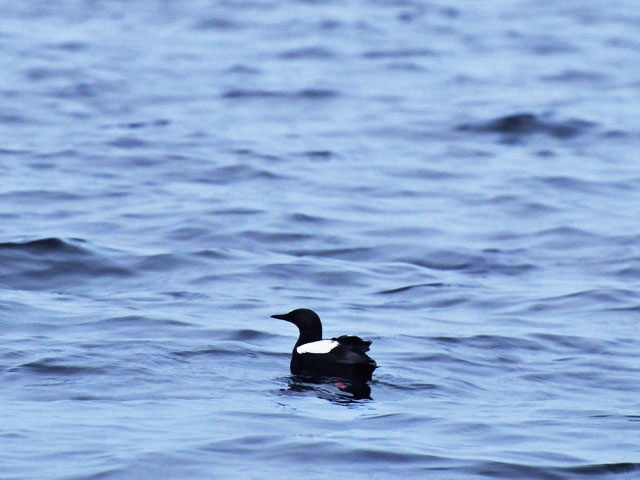
These small, compact oceanic birds – a life bird for me – were everywhere along the coast. Coal-black with a pointed dark bill, neatly upturned tail and white oval patches in the wings, they floated in the waves alone or in the company of many others, often close to shore. When one flew low across the water, it looked diminutive and dark, white flashing in the wings. Once in a while we could see their bright red legs and feet.

We first saw them from a rocky shore along the Ocean Path in the park, a place where we walked far out and sat on flat, sun-warmed pink granite rocks, and looked out over the water. Here there were many Black Guillemots bobbing in the waves and sometimes flying, along with a few Common Eider and Double-crested Cormorants, and Herring and Great Black-backed Gulls flying over and perched on the rocks.

Black Guillemots are members of the Alcid family, which also includes murres, auklets and puffins. They live in the cold waters of the Arctic and far northern Atlantic and polar regions, and nest on rocky shores.

The Allure of a Loon

August 7th, 2009

On small quiet lakes surrounded by trees, we watched several Common Loons – one or two at a time – maybe the most characteristic bird of our visit to Maine. Its name seems to me unfortunate, because a “common” loon is one of the most fabled and mythical of birds – large, dark and exquisitely patterned, with a preference for wilderness and solitude, and an aura of mystery. It’s called common because it lives further south than other loons, so is seen by more people.

Late one morning on a warm, sunny day, one Common Loon floated low in the water, not far out from where we stood along the shore, though unfortunately we didn’t have a camera at the time. For several minutes it stayed on the surface, not diving, so we could clearly see its ink-black head, red eye and long, pointed black bill; the black back checkered with white; on its throat, a thin crescent necklace of fine white stripes, and around its neck a wide white collar of stripes. After a few minutes, it began preening, raking its bill through feathers on its breast and under its wings. Four or five times, it rose up out of the water in a flurry of splashing, flapping wings, stretching up to show its pure-white breast and belly in a tall, extended posture that’s apparently part of its bathing routine – sort of shaking off at the end.

Though I listened and hoped, we never heard the call of a loon – an experience that continues to elude me.

Northern Flicker

July 20th, 2009

A walk around noon today was notable mainly for how very quiet birds were. When I first stepped out the door, I heard not a single bird, only the shrieking of cicadas. It was a pleasant day, sunny and warm, but not nearly as hot as usual for this time of year. Three or four Ruby-throated Hummingbirds zoomed around the feeder and the geraniums in the back yard, and there were the distant, scattered calls of Cardinal, Titmouse and Carolina Wren. But partly because of the time of year, partly the time of day, not much else was happening, with one exception.

A Northern Flicker gave its loud but level pileated-like rattle and flew into some bare branches at the top of a tree where its warm brown back, gray head and bright black bib and red crescent on the back of the neck glowed in the sun.

Wood Thrush and Eastern Wood-Pewee

July 19th, 2009

This morning – a rare cool summer morning, with temperatures in the mid 60s and the air feeling fresh and clean – two Wood Thrushes sang in the same low area of woods around a creek from where I heard one sing a few days ago. A quiet Black-and-white Warbler crept over the limbs of a large pecan tree nearby, on the edge of a thicket, and a Northern Parula was hidden somewhere in the foliage of the same tree, singing.

By 8:30 or so, the sun had already climbed well up into a soft blue sky with patches of broken white clouds rippling out like fish scales, turned by the sunlight into an amazing iridescent array of aqua-green, mauve, pink and salmon. Not quite a rainbow, but the aqua-green color, in particular, was very unusual and pretty.

Birds were more active and vocal than usual lately throughout the neighborhood – just on a morning walk I counted 28 species, even though some of the most common were missing – but the biggest surprise was an Eastern Wood-Pewee, singing its full, languid pee-a-wee – WHEE-ooo song from a small group of trees.

Black-and-white Warbler at my Window

July 15th, 2009

Late this morning as I was coming down the stairs in our front hall, I saw a small black and white bird fluttering around a long, narrow, rectangular window over our front door. It was a female or juvenile Black-and-white Warbler, very slender and pretty, with sharp black and white striping on the head, and black wings with bright white wing bars. It was looking into the window and apparently trying to get through it, repeatedly fluttering up against the glass and moving all along the length of the window. It did not appear to be foraging for spiders or insects, but just trying to get through the glass – and most frustrated at this invisible barrier to wherever it wanted to go.

Not easily discouraged, the little warbler fluttered up again and again for more than five minutes, I think, maybe as long as ten. Several times it stopped and tilted its head, as if studying the situation and trying to figure this out. Then it would fly up again, trying every spot along the way before it finally gave up, turned its back on the impassable glass and flew away.

This is a small window, and I’ve never known of a bird flying into it, but maybe from the right position they can see through it and through the kitchen windows on the other side of the house – outside of which are flowering plants and ferns on the deck, and trees beyond that.

Although we usually have several Black-and-white Warblers here during the summer, this year I have not heard or seen any since the spring, until now. So it was fun to see this one, and particularly interesting to watch its persistence and puzzlement, its attempts to solve the mystery, and eventual deduction that this just wasn’t going to work.